Quantum companies hire machine learning (ML) and artificial intelligence (AI) specialists for four kinds of work: decoding errors, calibrating processors, supporting simulation and research, and building AI tools and products. A separate group of researchers studies whether quantum computers can improve machine learning itself. Candidates should know which of these an employer describes in a listing before they apply.
Our November 14, 2026 snapshot has 25 listings whose titles name AI, machine learning, or a related specialty such as computer vision. They come from 14 employers. In a wider text search we found machine learning terms in 92 listings from 25 employers, and 21 of those are sales and solutions listings. We used different rules for the two searches, and only 16 of the 25 titled listings are among the 92. We cannot tell from a keyword match that building models is the main duty of a role.
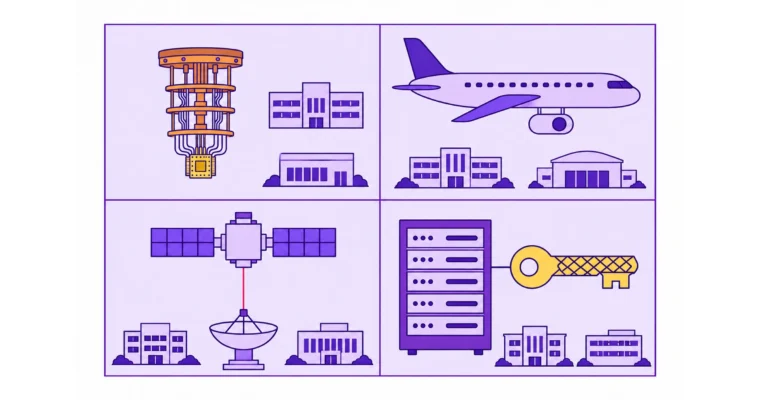
Four places where quantum teams use machine learning
Decoding
An error-corrected quantum computer measures a set of its qubits in every cycle and produces a stream of syndrome data. A decoder reads that stream and infers the correction to apply or the logical result of the computation. A decoder has to be accurate. It also has to process the stream as fast as the stream arrives, or a backlog builds. Where a later operation depends on a result, the decoder has to return that result in time.
Google DeepMind and Google Quantum AI trained a neural network decoder called AlphaQubit and published the result in Nature in November 2024. It decoded data from Google’s Sycamore processor more accurately than earlier decoders. Google said at the time that it was too slow for real-time use. The same group described a successor in an arXiv paper that it first posted in December 2025 and revised in March 2026. The authors report that the real-time version processes a distance-11 surface code in under one microsecond per cycle on commercial accelerators. The authors measured throughput in that test. The figure is not the delay between a measurement and a correction on working hardware.
NVIDIA released its Ising models as open source in April 2026. The two decoding models are convolutional networks with 0.9 million and 1.8 million parameters. NVIDIA calls them pre-decoders: each one removes most errors locally and passes the rest to a conventional decoder such as PyMatching. NVIDIA says the models improve on the previous state of the art by up to 2.5 times in speed and up to three times in accuracy. Those figures come from NVIDIA’s own benchmarks.
We describe the wider decoder field in our error correction careers guide.
Calibration
Engineers must calibrate control pulses, readout, and other hardware settings before a processor is usable, and they must repeat the work as the device drifts. Calibration by hand takes longer as processors grow. Teams now train models to read the measurement data and choose the next adjustment. NVIDIA’s Ising release includes a calibration model for this purpose. It is a vision-language model with 35 billion parameters.
D-Wave lists a Staff Software Engineer, ML/AI Calibration. Pasqal lists an AI scientist for quantum system performance optimization. Employers mention machine learning and calibration together in 11 of the 92 listings.
Simulation and research
Physicists simulate quantum hardware on classical computers to design chips, test codes, and generate training data. Machine learning engineers support that work with learned models that stand in for a slow simulation and with methods that choose the next experiment. Other engineers speed up numerical simulations directly on graphics processing units (GPUs) and train no model. Employers mention GPUs or CUDA in 28 of the 92 listings, so check which kind of work a listing describes.
NVIDIA has an example of each. Its Senior Quantum AI Research Scientist designs models for decoding and calibration and builds the datasets to train them. Its Senior Software Engineer for accelerated quantum chemistry builds numerical libraries for GPUs. NVIDIA also lists two PhD research internships that combine quantum simulation, chemistry, and AI.
AI tools and products
Several employers hire engineers to build AI tools. QuEra lists a Senior Applied AI Engineer who builds internal tools on large language models (LLMs) and agents. Atom Computing lists a Principal AI Developer Experience Engineer who sets the practices for AI-assisted coding on its control software. Kipu Quantum lists a Senior Software Engineer for agentic AI who builds the AI agents inside its customer platform.
Who hires
| Employer | ML or AI titles | Example title |
|---|---|---|
| Sygaldry Technologies | 4 | Applied AI Scientist (Senior/Principal) |
| D-Wave Quantum | 3 | Staff Software Engineer, ML/AI Calibration |
| NVIDIA | 3 | Senior Quantum AI Research Scientist, Applied Research |
| Oratomic | 2 | AI Scientist |
| Pasqal | 2 | Senior Quantum Solutions Engineer – ML |
| Oxford Quantum Circuits | 2 | Applied Scientist (Computer Vision) |
| Kipu Quantum | 2 | Senior Software Engineer (Agentic AI & Agentic Engineering) |
Alice & Bob, Atom Computing, Quandela, QuEra, Riverlane, Silicon Quantum Computing, and Terra Quantum each have one.
Employers leave machine learning out of the title of many roles that involve it. NVIDIA has 23 listings on the board in total. They include a Senior Quantum Applied Research Scientist, Calibration and Decoding and a Senior Engineer for quantum error correction libraries. Of the 92 listings where employers mention machine learning in the text, 22 are software listings and 14 are error correction listings.
Roles that apply quantum computers to AI
Some employers hire people to apply quantum computers to machine learning. Kipu Quantum lists a Quantum Engineer for quantum machine learning. Oxford Quantum Circuits lists a Quantum Algorithm Engineer for generative models. Sygaldry Technologies lists a Quantum-AI Postdoctoral Fellow and a Research Scientist for frontier AI/ML and quantum algorithms.
These are research roles. Researchers have not settled whether a quantum computer can beat strong classical methods on a practical machine learning workload. They have shown advantages on specially constructed tasks, and those results do not decide the practical case. A candidate should ask which dataset and which classical baseline the team uses. Ask also whether the team ran the results on hardware and whether it counted data loading and error correction in the comparison. Check whether the listing mentions a PhD and publications, as we explain in quantum software engineer vs. quantum algorithm researcher.
What employers ask for
Employers name PyTorch, JAX, or TensorFlow in 19 of the 92 listings. Employers add requirements for the decoding and calibration roles that most machine learning jobs do not have.
- Fast inference under a timing budget. Decoder engineers must meet the target system’s throughput, latency, and accuracy requirements. Teams run decoders on field-programmable gate arrays (FPGAs), custom chips, CPUs, or GPUs, depending on the algorithm and the timing budget. Engineers who have optimized inference on any of them have relevant experience.
- Simulated training data. Experimental data from a quantum processor is scarce. The AlphaQubit team trained on simulated errors first and then fine-tuned on data from the processor.
- Enough physics to read the data. A machine learning engineer in these teams needs to learn what a syndrome is and how noise differs between hardware types.
Candidates who want to prepare can run the open models and tools. NVIDIA publishes the Ising models and its CUDA-Q platform as open source. A useful exercise is to benchmark a decoder and report its logical error rate and its speed separately.
Posted salary ranges
Six employers posted the ten annual US dollar ranges we found on the 25 titled listings. The median posted range is US$183,500–270,500, with a median midpoint of US$228,000. The median midpoint across all 541 annual US dollar ranges on the board was US$173,500 on November 14, 2026.
Ten ranges is a small sample, and we cannot measure a premium for machine learning skills from it. Sygaldry Technologies posted four of the ten and Oratomic posted two. Both Oratomic listings are open to all experience levels at US$200,000–350,000. Four of the ten are lead or principal roles.
The median posted range pairs the median minimum with the median maximum. The median midpoint is the median of each listing’s own midpoint. A range is what an employer advertises and is not an offer. We explain the method in our salary snapshot, which reports figures from November 12.
Who should apply
Machine learning engineers with experience in real-time inference, scientific computing, or reinforcement learning for control have the closest fit for the decoding and calibration roles. Engineers who have built LLM applications, retrieval, and agents fit the tools and product roles. Engineers who have worked with FPGAs can also read our guide to control electronics roles.
In most of these roles the engineer builds for scientists and other engineers. Read the duties and the deployment target of each listing before you judge the work by the employer’s sector.
Browse the open software and algorithm roles on Quantum Careers.