Riverlane’s Quantum Error Correction Report 2025 estimated that only 600 to 700 people specialize in quantum error correction (QEC) worldwide, and that the industry will need 5,000 to 16,000 by 2030. On November 12, 2026, 41 open roles on Quantum Careers named error correction, decoding, or fault tolerance in the title. They came from 19 employers on three continents. Nineteen of them posted a US salary range, with a median midpoint of US$187,500.
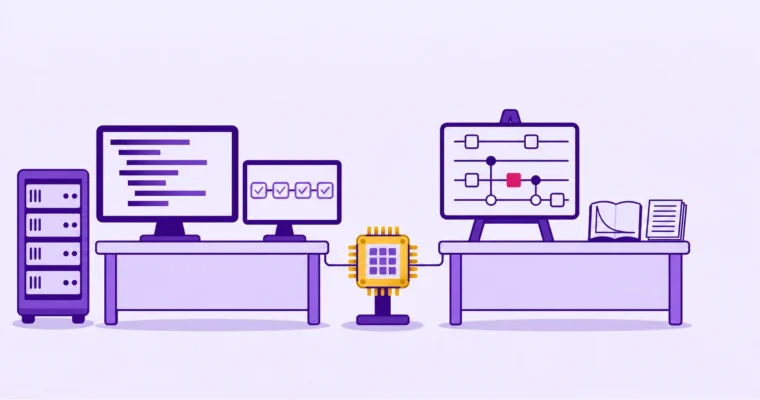
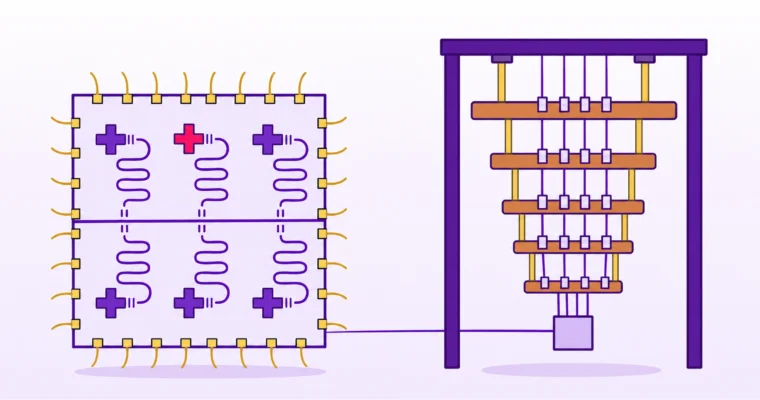
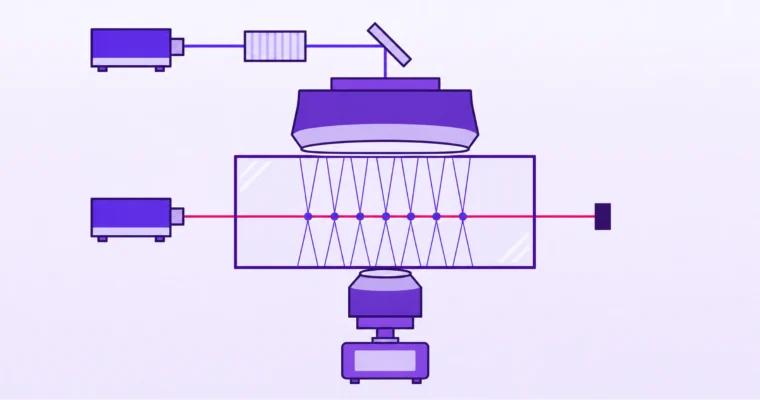
QEC is the work that turns noisy physical qubits into reliable logical qubits. Every company building a fault-tolerant quantum computer needs it, whichever hardware it uses. That makes it one of the few quantum specialties where a candidate’s skills transfer across superconducting, trapped-ion, neutral-atom, photonic, and spin-qubit employers.
What error correction work involves
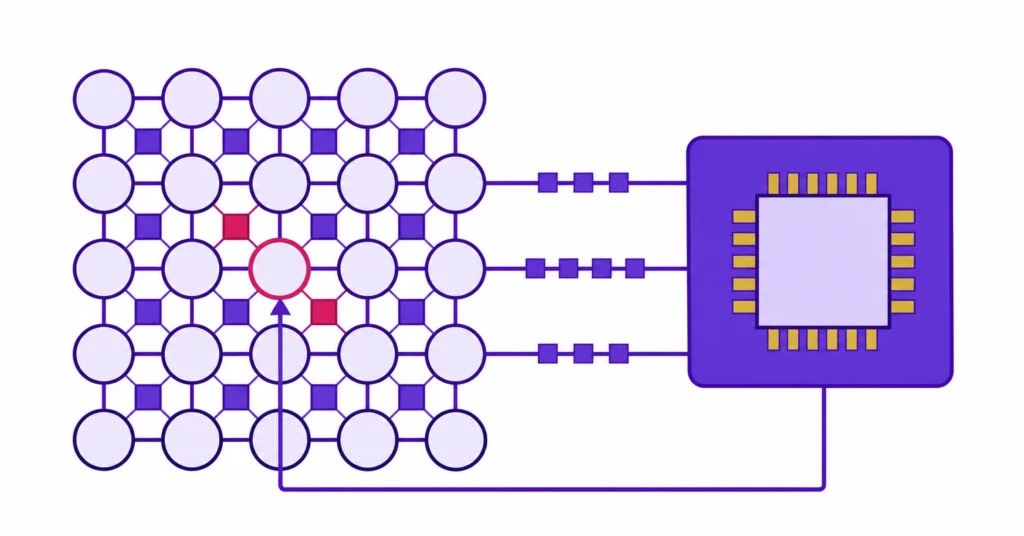
A logical qubit is encoded across many physical qubits. The machine repeatedly measures a set of parity checks. The pattern of outcomes, called the syndrome, indicates where errors have probably occurred without measuring the encoded logical information directly. A decoder, running in software or dedicated hardware, reads the syndromes and infers the most likely correction. The cycle repeats for as long as the computation lasts.
Two results from the past two years moved QEC from theory into engineering. In December 2024, Google Quantum AI reported a distance-7 surface code memory on its Willow processor, built from 101 physical qubits, with a logical error rate of 0.143% per cycle. The logical error rate fell each time the team enlarged the code, the condition known as operating below threshold. In November 2025, Quantinuum reported a demonstration that encoded 48 error-corrected logical qubits in the 98 physical qubits of its Helios trapped-ion system.
Real-time decoding is one important bottleneck. Riverlane’s report calls it a critical bottleneck and says decoders must move from software prototypes to specialized hardware, such as field-programmable gate arrays (FPGAs) and application-specific integrated circuits (ASICs). A decoder has to keep pace with the syndrome data the machine produces. Any logical operation that depends on a measurement result has to wait for the decoder’s answer. In the Willow experiment, Google ran a real-time decoder with an average latency of 63 microseconds at distance 5, against a correction cycle of 1.1 microseconds. Employers now hire engineers specifically to build these decoders.
Government programs add to the demand. DARPA’s Quantum Benchmarking Initiative tests whether any approach can reach a utility-scale, fault-tolerant machine. On October 7, 2026, DARPA moved four more companies, Atom Computing, Diraq, IBM, and IonQ, into the final stage of hands-on verification. Every architecture in that program depends on error correction.
The roles
Job titles in QEC are not yet standard. The same work can appear as “Quantum Scientist”, “Research Scientist”, or “Engineer”, depending on the employer. The titles below come from listings open on Quantum Careers in November 2026.
QEC theorists and scientists
Theorists design codes, decoders, and the logical operations that run on encoded qubits. They estimate thresholds and overheads, and they adapt general code families to the physics of a specific machine. Current listings include a Quantum Error Correction Theorist at Sygaldry Technologies, Oratomic, and D-Wave Quantum, Quantum Scientists in decoding and QEC theory at QuEra Computing, QEC researchers at Riverlane, and a PhD position at Alice & Bob on error correction codes for cat qubits. Most of these roles ask for a PhD in physics, computer science, or mathematics with published QEC work.
Decoder and QEC software engineers
Decoder engineers turn a decoding algorithm into software or hardware that keeps pace with the machine. The work ranges from optimized C++ and Rust to GPU code and FPGA logic, and it is measured in latency and throughput. Listings for a Quantum Error Correction Engineer at IQM Quantum Computers, planqc, and Pasqal, and a Software Engineer in Control and Error Correction at Silicon Quantum Computing, describe this mix of algorithm and systems work. NVIDIA lists a Senior Engineer for its QEC libraries. Infleqtion has two openings for quantum software engineers working on error correction.
Experimental QEC engineers
Experimental engineers run error correction on real hardware. They design the experiments, operate the control system, and analyze where the logical error rate departs from the model. IQM’s listing for a Quantum Error Correction Experiment Engineer is an example. These roles suit experimental physicists who want to work on the logical layer of the machine.
Fault-tolerant architecture and resource estimation
Architects decide how a machine will run error-corrected programs: how many physical qubits each logical qubit needs, how logical operations are scheduled, and what the control system must do to support them. Resource estimators work out how large a machine a given algorithm requires. Current listings include a Senior Microarchitecture Researcher at IonQ, a Fault Tolerant Quantum Algorithms Researcher at Quantinuum, a Staff Research Scientist in fault-tolerant applications at Q-CTRL, and a physical resource estimation internship at Alice & Bob.
QEC product and team leadership
As QEC moves from research into products, employers are hiring people to lead it. Open roles include a Product Manager for QEC Software at IQM, a Quantum Error Correction Manager at Pasqal, a Quantum Error Correction Lead at Equal1, and a Senior Manager for Quantum Error Correction at Sygaldry Technologies.
Who hires
| Employer | QEC roles on Quantum Careers | Hardware | Locations named in listings |
|---|---|---|---|
| Riverlane | 8 | Hardware-agnostic decoding | Cambridge (UK), Boston, College Park, Delft |
| QuEra Computing | 6 | Neutral-atom | Boston |
| IQM Quantum Computers | 3 | Superconducting | Munich, Espoo |
| NVIDIA | 3 | Hardware-agnostic software | Santa Clara, Redmond, New York |
| Sygaldry Technologies | 3 | Not stated | Ann Arbor, Copenhagen |
| Q-CTRL | 2 | Hardware-agnostic software | Los Angeles |
| planqc | 2 | Neutral-atom | Garching, Innsbruck |
| Pasqal | 2 | Neutral-atom | Palaiseau and other sites |
| Infleqtion | 2 | Neutral-atom | Chicago, Kidlington (UK) |
| Alice & Bob | 1 | Superconducting cat qubits | Paris |
| D-Wave Quantum | 1 | Superconducting | New Haven |
| IonQ | 1 | Trapped-ion | Bothell |
| Quantinuum | 1 | Trapped-ion | Broomfield |
| Universal Quantum | 1 | Trapped-ion | Haywards Heath |
| Equal1 | 1 | Silicon spin | Dublin, Delft, Sherbrooke |
| Quantum Motion | 1 | Silicon spin | London |
| Silicon Quantum Computing | 1 | Silicon spin | Sydney |
| Oratomic | 1 | Neutral-atom | Pasadena |
| Quandela | 1 | Photonic | Massy |
Riverlane, which builds decoding hardware and software for other companies’ machines, has the most QEC listings on the board. Google Quantum AI and IBM run large in-house QEC groups but do not list roles on the board today. Current QEC listings on Quantum Careers are under quantum computing hardware and software and algorithms.
Posted salary ranges for QEC roles
Nineteen of the 41 QEC listings posted an annual US salary range. The median of their posted minimums was US$145,000 and the median of their maximums US$225,000, with a median midpoint of US$187,500. The salary snapshot puts the median midpoint across all 506 US listings with a range at US$175,000. The snapshot’s error correction and system architecture group has 28 ranges and a median midpoint of US$200,000. That group also includes system and datacenter architecture roles.
| Role | Employer | Posted range |
|---|---|---|
| Quantum Scientist, QEC and Decoding | QuEra Computing | US$130,400–211,900 |
| QEC Researcher | IonQ | US$160,000–240,000 |
| Senior Research Scientist, Quantum Error Correction | Q-CTRL | US$150,000–225,000 |
| Fault Tolerant Quantum Algorithms Researcher | Quantinuum | US$150,000–250,000 |
| Staff Research Scientist, Fault-Tolerant Applications | Q-CTRL | US$185,000–265,000 |
| Quantum Error Correction Theorist | Oratomic | US$200,000–350,000 |
| Quantum Innovation Postdoctoral Fellow, QEC | QuEra Computing | US$110,000–120,000 |
| Lead Quantum Error Correction Researcher (US) | Riverlane | US$145,000–240,000 |
| Senior Quantum Error Correction Research Scientist, Applied Research | NVIDIA | US$192,000–304,750 |
| Quantum Error Correction Theorist II | D-Wave Quantum | US$86,800–130,300 |
The ranges are wide. The QuEra, Oratomic, and NVIDIA ranges span US$80,000 or more, which leaves room to negotiate on experience and publication record. In Europe, only Riverlane posted ranges for QEC roles, in pounds for Cambridge and in euros for Delft. Our article on EU pay transparency explains why that will change.
How to move into QEC
Riverlane’s report says that training a QEC specialist can take up to ten years. That reflects the academic route, a PhD and postdoc in quantum information. Other routes are shorter for people who bring a matching skill from outside quantum.
- Classical coding theorists and communications engineers. Low-density parity-check (LDPC) codes and their decoders are standard in 5G and storage. IBM researchers made the case for quantum LDPC codes as a lower-overhead alternative to the surface code in theoretical and numerical work on quantum LDPC memories. Experience with belief-propagation decoding is a strong starting point, although quantum LDPC codes usually need it paired with a second-stage decoder.
- FPGA and ASIC engineers. Real-time decoding is a low-latency hardware problem. Engineers who have built forward error correction for telecom or signal processing for radar know the constraints.
- High-performance computing and systems programmers. Decoder software has to process syndrome data at high rates with predictable latency.
- Experimental physicists. Hardware groups need people who can run QEC experiments and diagnose correlated errors.
The open-source tools are the fastest way in. Google’s Stim simulates error-correction circuits at scale, and 19 listings on the board name it. PyMatching implements a widely used decoder for surface codes. Reproducing a published threshold plot with them gives a hiring manager concrete evidence of the skill. Our guide to decoding quantum job descriptions explains the QEC terms that appear in listings.