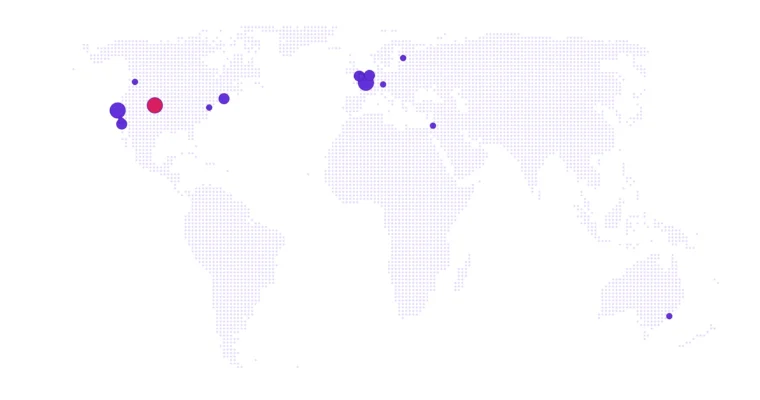
On November 12, 2026, 73 of the 1,137 open roles on Quantum Careers were tagged fully remote, about 6%. Another 156 were hybrid. The remaining 908 were on-site. Two in five remote roles, 29 of 73, were in sales, solutions, or customer engineering. Of 430 quantum computing hardware roles, 11 were remote.
Candidates looking for remote quantum work will find some, mostly outside the lab. The counts here use the workplace tag on each listing. Some descriptions do not match their tag, in either direction, so the counts are approximate.
Where the remote roles are
The table covers the four largest technology areas, 1,045 of the 1,137 roles. The other 92 are in systems integration, sensing, security, communications, and policy.
| Technology area | Roles | Remote | Hybrid | On-site |
|---|---|---|---|---|
| Quantum computing, hardware | 430 | 11 | 49 | 370 |
| Quantum computing, software and algorithms | 221 | 16 | 35 | 170 |
| Quantum-adjacent (sales, product, corporate) | 192 | 32 | 44 | 116 |
| Enabling technologies | 202 | 7 | 18 | 177 |
The 73 remote roles came from 12 employers. Quantum Machines listed 18, most of them customer success and product solution physicists. IonQ listed 17, most of them in partnerships, sales, customer success, finance, and legal. NVIDIA listed 14 and D-Wave Quantum nine. PQShield, a post-quantum cryptography company, listed four, and so did Quantinuum. PsiQuantum, Rigetti Computing, Q-CTRL, IQM Quantum Computers, Pasqal, and Universal Quantum listed one or two each.
Most remote listings limit applicants to particular countries. Fifty-three of the 73 named the United States. Singapore appeared in three, the UK in two, and Australia, Canada, France, Hungary, the Netherlands, South Korea, and Switzerland in one each. Nine did not name a country. Employment law, payroll, and tax registration depend on the employee’s country of residence. Many employers can only hire in countries where they have a legal entity.
The remote technical roles involve design, analysis, or work at customer sites. Quantinuum listed a senior photonic integrated circuit design role and a quantum computer deployment physicist as remote. The deployment role is remote because the work takes place at customer installations. PsiQuantum listed a photonic design engineer, Pasqal a quantum error correction engineer, IonQ a quantum applications scientist, and PQShield a lead software engineer. NVIDIA listed a quantum algorithm researcher and an engineer for its error correction libraries as remote, and D-Wave Quantum a senior FPGA engineer.
Why most technical roles are on-site
Quantum hardware is built and operated in laboratories, cleanrooms, and test facilities. Engineers align lasers and maintain dilution refrigerators and vacuum systems. Fabrication teams make and package the chips. Hands-on assembly, alignment, and maintenance generally require physical access to the equipment. On the snapshot date, 370 of the 430 hardware roles on the board were fully on-site.
Software and algorithms roles were mostly on-site too, 170 of 221. Most of them are at hardware companies. A likely reason is that compiler, calibration, and control software teams work next to the machines their code controls. A failed calibration may need someone in the lab. The listings rarely say why.
Export controls restrict some employers further. Several countries control the export of quantum computing technology. Under the US deemed-export rule, releasing controlled technology to a foreign national inside the United States counts as an export to that person’s home country. Remote access from abroad raises similar questions, and other countries’ rules differ. Our guide to visas, relocation, and security clearances explains how export controls affect quantum hiring.
Hybrid is the common form of flexibility
Hybrid roles outnumbered remote roles about two to one. Alice & Bob listed 38 hybrid roles, Quantinuum 24, and Quantum Machines 23. Q-CTRL listed 14, Atom Computing 11, and IQM and Pasqal 10 each. Hybrid work was more common in Europe. Of the 382 listings tagged to European locations, 66 were hybrid, about 17%. In North America the figure was 64 of 645, about 10%.
Hybrid arrangements vary. Some employers expect three or four days a week in the office, and others set a monthly minimum. Hardware roles listed as hybrid usually require regular lab time. Ask for the expected number of office days before applying.
Posted salary ranges for remote roles
The 42 remote listings with an annual US salary range had a median midpoint of US$206,000. On-site roles had a median midpoint of US$172,000. Thirty-seven of those 42 remote roles were at senior level or above, and NVIDIA posted 13 of them. Without NVIDIA’s ranges, the remote median midpoint is US$180,000. Senior and commercial roles post higher ranges than the typical on-site hardware role, so the comparison mixes different jobs. It does not show a premium for remote work itself. The salary snapshot has the full breakdown.
Where to look, and what to ask
Remote quantum work is most common in four areas:
- Commercial roles at quantum companies: partnerships, sales, customer success, solutions engineering, and field engineering.
- Post-quantum cryptography and quantum security. The products are software and the customers are spread across many countries. Our guide to PQC careers covers those roles.
- Design and simulation roles in photonics, error correction, and applications research.
- Corporate functions such as legal, finance, and government affairs.
Before applying for a remote role, check which countries the employer can hire in and how much travel the role requires. Ask whether any part of the work involves controlled technology. Current remote listings are under remote quantum jobs.