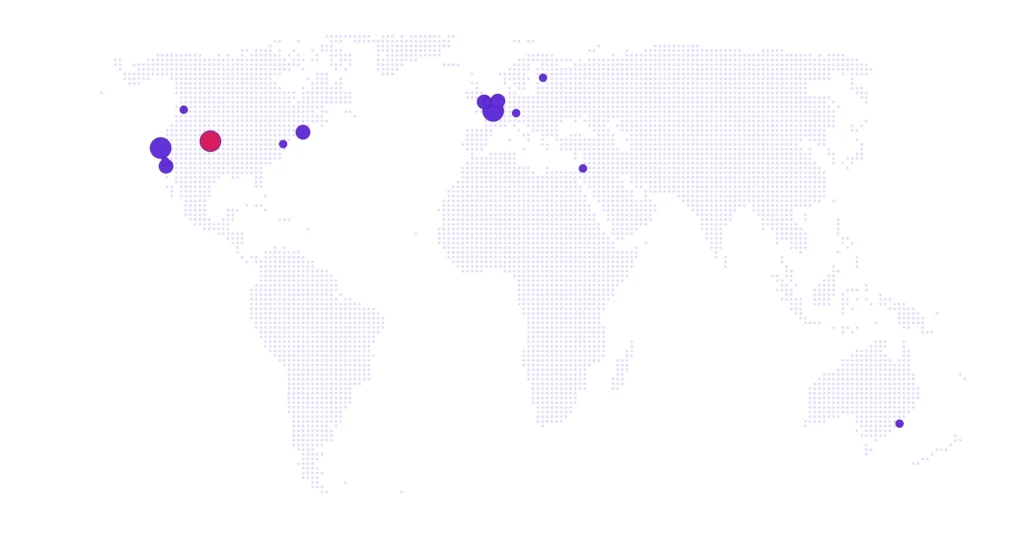
A candidate who is weighing a move needs to know three things about a city: how many relevant listings it has, how many employers post them, and whether a second employer is nearby if the first job ends. Our November 14, 2026 snapshot has 1,287 listings from 43 employers in 25 countries. The four largest hubs are Colorado’s Front Range, the Paris region, the San Francisco Bay Area, and Greater Boston. Together they have 524 of the listings.
For most of these listings, the candidate must live near the employer. Employers mark 1,020 of the 1,287 on-site and 75 remote.
How we counted
We counted listings on Quantum Careers on November 14, 2026. A listing is one advertisement on an employer’s careers site. An employer may fill several positions from one listing.
We counted a listing once in each hub where the employer says the job can be based, even when the employer names two cities in that hub. A listing can count in two hubs. Three IonQ listings are open in both Colorado and the Bay Area. The four largest hubs therefore have 524 listings between them, and their rows in the table add up to 527. In country and state totals we counted each listing once.
A hub is a group of nearby cities that we defined. The Front Range runs from Denver through Broomfield and Boulder to Fort Collins. The Bay Area includes Milpitas, Palo Alto, Santa Clara, Berkeley, and San Francisco. Check the commute between two sites before you treat them as one job market.
Employers name no location in 47 listings. The board covers 43 employers. IBM, Google, and Microsoft run large quantum teams, and their openings are not in these figures. A city with one employer on our board may have others that we do not list.
The largest hubs in our snapshot
| Hub | Listings | Employers | Largest employers on the board |
|---|---|---|---|
| Colorado Front Range | 188 | 7 | Quantinuum 88, Atom Computing 38, Infleqtion 30, IonQ 18 |
| Paris region | 130 | 4 | Quandela 59, Alice & Bob 42, Pasqal 21 |
| San Francisco Bay Area | 126 | 8 | PsiQuantum 77, NVIDIA 15, Rigetti Computing 13, IonQ 11 |
| Greater Boston | 83 | 7 | QuEra Computing 62, Riverlane 7 |
| San Diego | 78 | 1 | Monarch Quantum 78 |
| Delft | 62 | 7 | QuantWare 32, Qblox 18 |
| Oxford and the Thames Valley | 62 | 6 | Oxford Quantum Circuits 27, IonQ 23, Infleqtion 9 |
| Washington, DC, and Maryland | 36 | 6 | IonQ 22, Riverlane 6, Phasecraft 5 |
| Cambridge, England | 34 | 4 | Riverlane 17, Nu Quantum 8, Quantinuum 5 |
| Munich area | 32 | 5 | planqc 15, IQM Quantum Computers 13 |
| Los Angeles area | 31 | 3 | Oratomic 18, Q-CTRL 10 |
| London | 29 | 6 | Quantum Motion 13, Quantinuum 7 |
| Sydney | 27 | 3 | Q-CTRL 16, Silicon Quantum Computing 9 |
| Helsinki area | 26 | 3 | IQM Quantum Computers 20 |
| Greater Vancouver | 26 | 2 | Photonic Inc. 14, D-Wave Quantum 12 |
| Tel Aviv | 24 | 2 | Quantum Machines 23 |
United States
California has 227 listings and Colorado has 188. Massachusetts has 83, all of them in Greater Boston.
Colorado’s Front Range is the largest hub on the board. Quantinuum lists 88 roles in Broomfield, Atom Computing 38 in Boulder, and Infleqtion 30, most of them in Louisville. IonQ and Maybell Quantum also hire there. The federal government has designated the region a Tech Hub for quantum technology. The consortium that runs it, Elevate Quantum, covers Colorado, New Mexico, and Wyoming. The US Economic Development Administration awarded it US$40.5 million in July 2024. Colorado committed US$74 million in tax credits and a loan-loss reserve.
The San Francisco Bay Area has 126 listings from eight employers. PsiQuantum lists 77 of them in Milpitas and Palo Alto. Rigetti lists 13, most of them in Berkeley. NVIDIA lists 15 in Santa Clara.
Greater Boston has 83 listings, and QuEra has 62 of them. Boston and Colorado’s Front Range are the two largest hubs for neutral-atom work on the board. We describe those roles in our neutral-atom guide.
San Diego has 78 listings, all from Monarch Quantum. Laser, optics, and photonics engineering is its largest role family.
Washington, DC, and Maryland have 36 listings. IonQ lists 22, most of them in College Park. Five employers have listings in Washington, DC, itself.
The Seattle area has 22 listings, from IonQ and NVIDIA.
D-Wave has ten listings in New Haven, Connecticut, where it runs a research and development center. It completed its acquisition of Quantum Circuits on January 20, 2026.
Europe
Europe has 471 listings on the board. The United Kingdom has the most employers of any European country, with 18.
The Paris region has 130 listings from four employers. Quandela lists 59, most of them in Massy. Alice & Bob lists 42 in Paris and Aubervilliers. Pasqal and C12 Quantum Electronics have the others.
Delft has 62 listings from seven employers, with 32 at QuantWare and 18 at Qblox. We describe QuantWare’s kind of work in our guide to superconducting hardware.
The United Kingdom has 158 listings in several places. Oxford Quantum Circuits lists 27 roles in Reading, and IonQ lists 23 in Oxford. Riverlane lists 17 in Cambridge. Quantum Motion lists 13 in London, and Universal Quantum lists 20 in Haywards Heath. The UK government announced up to £2 billion for quantum technologies in March 2026, with £1 billion of it for a program to procure quantum computers. We cannot tell from that announcement how many roles employers will open.
Germany has 58 listings from 11 employers, and the Munich area has 32 of them. The employers with the most listings there are planqc in Garching and IQM in Munich.
Finland has 26 listings, and IQM has 20 of them in Espoo.
Denmark has seven listings today. Atom Computing and Microsoft are building a machine called Magne for QuNorth, a venture of Denmark’s export and investment fund and the Novo Nordisk Foundation. The partners expect it to begin work around the start of 2027.
Asia-Pacific and Israel
Sydney has 27 listings, 16 at Q-CTRL and nine at Silicon Quantum Computing. Tel Aviv has 24, and Quantum Machines has 23 of them. Japan has 21 listings from nine employers, including eight QuEra roles in Tsukuba. Singapore has 18 listings from five employers.
What to check before you move
Count the employers as well as the listings. Our board has one employer in San Diego, one in Reading, and one in Massy. Before you move to a city like that, check the wider local market for a second employer that hires your skills. Colorado, the Bay Area, Boston, and Delft each have seven or eight employers on the board.
Check who may hold the job. Employers state a US-person or citizenship requirement in 174 of the 648 US listings. Quantinuum and Monarch Quantum post 166 of them. Ninety of the 174 name export control rules. Three more US listings require a security clearance. Permission to work, access to export-controlled technology, and security clearance are three separate checks. We counted what employers write in listings, and we cannot tell from a listing what the law requires for the role. We explain the terms in visas, relocation, and security clearances.
Compare posted ranges by hub. Employers in the United States post enough ranges for a comparison.
| US hub | Ranges | Median posted range | Median midpoint |
|---|---|---|---|
| Seattle area | 21 | US$184,000–287,500 | US$235,000 |
| Los Angeles area | 28 | US$167,500–250,000 | US$205,000 |
| San Francisco Bay Area | 113 | US$176,500–214,000 | US$192,000 |
| Washington, DC, and Maryland | 33 | US$146,000–209,000 | US$177,500 |
| Greater Boston | 55 | US$130,500–208,000 | US$171,000 |
| Colorado Front Range | 160 | US$148,000–185,000 | US$166,500 |
| San Diego | 74 | US$130,000–177,500 | US$152,500 |
Do not read a row as the pay one candidate would get after a move. The hubs have different employers and different mixes of levels. IonQ and NVIDIA posted all 21 Seattle ranges, and the median midpoint without NVIDIA is US$201,500. Oratomic posted 18 of the 28 Los Angeles ranges, and the median midpoint without them is US$187,500. Monarch Quantum posted every San Diego range. PsiQuantum posted 69 of the 113 Bay Area ranges and sets pay by geographic zone. Compare the level and duties of a listing with your own, then compare the range with housing costs in that city.
The median posted range pairs the median minimum with the median maximum. The median midpoint is the median of each listing’s own midpoint, so it need not fall halfway between the two. Employers describe most of these ranges as base salary, and a range is not an offer. We explain the method in our salary snapshot, which reports figures from November 12, two days earlier.
Listings outside the United States have few ranges. We describe what the EU rules require in Europe’s pay transparency rules.
Do not plan around remote work. Employers mark 75 of the 1,287 listings remote. We list where those roles exist in remote quantum jobs.
For a view of the same market by employer, read the quantum talent map. Browse all open roles on Quantum Careers.