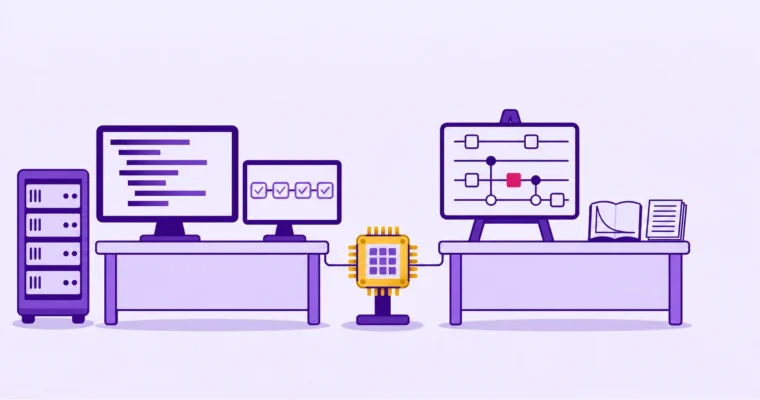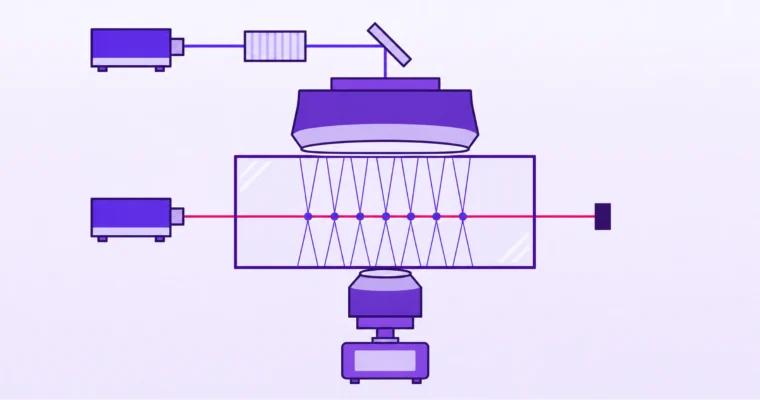
Superconducting hardware teams hire six kinds of specialist. They are processor designers and fabrication engineers, microwave and control electronics engineers, cryogenic engineers, technicians, the quantum engineers who calibrate the finished machine, and error correction staff. Our November 14, 2026 snapshot has 162 listings tagged superconducting from eight employers. Europe has 114 of them.
A listing is one advertisement on an employer’s careers site. The board does not list every employer, so these counts describe our snapshot and not the whole market.
How a superconducting quantum computer is built
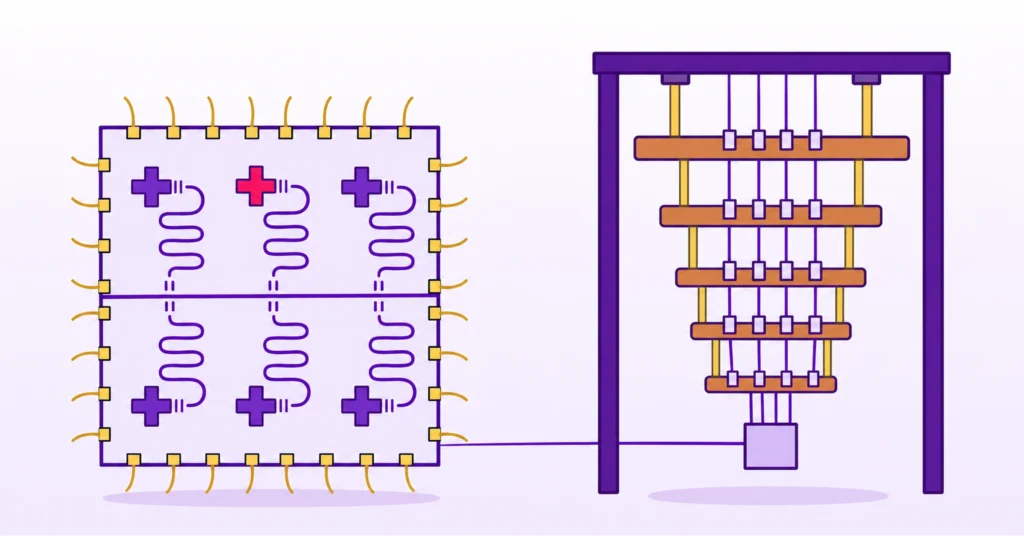
Engineers pattern superconducting circuits on a chip, commonly in aluminum or niobium on silicon or sapphire. The circuits contain Josephson junctions, each a thin insulating barrier between two superconductors. A dilution refrigerator cools the chip to millikelvin temperatures, a few hundredths of a degree above absolute zero.
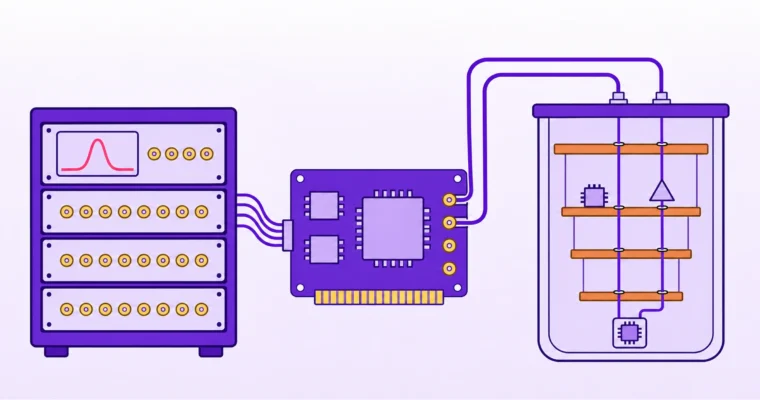
Companies use those circuits in different ways. Many gate-based machines have transmon-style qubits, which engineers operate with microwave pulses and flux-control signals sent down coaxial cables from room-temperature electronics. D-Wave builds its annealing systems from networks of flux qubits. Alice & Bob stores information in the microwave resonators of its cat qubits, and the dual-rail qubits that D-Wave acquired with Quantum Circuits also use resonators.
Every superconducting company therefore needs people from four older industries. Those industries are semiconductor fabrication, microwave engineering, cryogenics, and embedded electronics.
Google demonstrated error correction below the surface code threshold on its Willow processor, in a paper that Nature published in December 2024. Its distance-7 logical memory used 101 physical qubits. IBM’s roadmap lists Kookaburra for 2026, to demonstrate one module of Starling. IBM targets 2029 for Starling, a machine designed for 200 logical qubits. Rigetti reported a median two-qubit gate fidelity of 99.5% on its 108-physical-qubit system in November 2026, from its own testing. Rigetti targets a system of more than 300 physical qubits by mid-2028.
Google’s result is demonstrated. Rigetti measured its own fidelity figure. The IBM and Rigetti dates are targets.
Companies that build larger processors need more people in specific roles. A larger chip needs more control and readout signals. Engineers have to route those signals into the refrigerator while they manage heat, crosstalk, and limited space. They use multiplexing, denser packaging, and cryogenic electronics to do it. Rigetti said its planned system of more than 300 physical qubits needs faster readout and more cryogenic capacity. Electronics and cryogenic engineers do that work.
The roles
We grouped the 162 listings by job title. We placed 81 of them in six groups that are specific to this hardware.
| Role group | Listings | What the person does | Example titles |
|---|---|---|---|
| Quantum engineering and calibration | 25 | Tunes gates and readout, automates calibration, and benchmarks the processor | Quantum Engineer, Gates (IQM); Quantum Software Engineer – Calibration Operations (Oxford Quantum Circuits) |
| Processor design, fabrication, and packaging | 16 | Designs qubits and resonators, simulates the layout, then fabricates and packages the chip | Quantum Engineer, Fabrication (IQM); 3D Packaging Engineer (QuantWare) |
| Microwave and control electronics | 15 | Designs the RF chain, amplifiers, and FPGA boards that generate and capture the control signals | Senior RF Engineer – Quantum Control (Alice & Bob); Senior FPGA Engineer (D-Wave) |
| Technicians | 11 | Runs cleanroom processes and assembles electrical and mechanical hardware | Nanofabrication Technician (QuantWare); Electrical Production Technician II (D-Wave) |
| Cryogenic and mechanical engineering | 8 | Designs the refrigerator wiring, thermal stages, and mounts | Senior Cryogenic Systems Engineer (D-Wave); Senior Mechanical Engineer – Cryogenic (Rigetti) |
| Error correction | 6 | Designs codes and runs error correction experiments on the hardware | Quantum Error Correction Engineer (IQM); Staff Scientist – QEC Theory (Oxford Quantum Circuits) |
The other 81 listings are software, product and program management, internship, sales, research, and corporate roles.
Quantum engineers run the processor once it is cold. They tune each gate and the readout of each qubit. Many also write software that recalibrates the machine without a person at the console. IQM lists separate roles for gates, readout, calibration automation, and benchmarking.
Processor designers simulate qubits, couplers, and resonators in electromagnetic software before anyone fabricates them. Employers name Ansys HFSS, COMSOL, or Sonnet in 15 of the 117 engineering and science listings. Fabrication engineers then deposit and etch the superconducting films and form the junctions in a cleanroom. Packaging engineers connect the finished chip to its microwave lines. Candidates can read about this path in the guide to fab, test, and technician roles.
Microwave and control electronics engineers build the signal chain between the room-temperature electronics and the chip. They design filters, attenuators, and parametric amplifiers. They also design the field-programmable gate array (FPGA) boards that time each pulse. QuantWare and Oxford Quantum Circuits both list roles for superconducting amplifier design. For this family across all hardware types, see control electronics for quantum computers.
Cryogenic engineers design the wiring and thermal stages inside the refrigerator and keep the systems running. Two refrigerator makers are also on the board. Bluefors has 28 listings and Maybell Quantum has 24.
Error correction staff at superconducting companies design codes and run experiments on the hardware. Their roles are described in the error correction careers guide.
Who hires
Six companies have 160 of the 162 listings.
| Employer | Listings | Main locations |
|---|---|---|
| D-Wave Quantum | 34 | Burnaby, British Columbia; New Haven, Connecticut |
| Alice & Bob | 30 | Paris and Aubervilliers, France |
| Oxford Quantum Circuits | 29 | Reading, England |
| QuantWare | 29 | Delft, Netherlands |
| IQM Quantum Computers | 25 | Espoo, Finland; Munich, Germany |
| Rigetti Computing | 13 | Berkeley, California |
Q-CTRL and Bluefors each have one more listing with this tag.
The six companies build different machines. D-Wave sells annealing systems and is adding gate-model machines. It completed its acquisition of Quantum Circuits on January 20, 2026, in a deal it had announced at US$550 million. D-Wave has ten listings in New Haven, Connecticut, where it runs a research and development center. Alice & Bob builds cat qubits, a design intended to cut the number of physical qubits each logical qubit needs. QuantWare sells processors to organizations that assemble their own machines.
IBM and Google also run large superconducting programs, and their openings are not in these counts.
What employers ask for
We searched the listings for the words employers use. We left out sales, product, corporate, and internship roles, which leaves 117 engineering and science listings. Employers name Python in 61 of them and cryogenic or dilution refrigerator experience in 57. They mention a PhD in 52 and microwave or radio-frequency (RF) skills in 48.
Employers mention a PhD in fewer than half of these listings. A mention may be a requirement, a preference, or one route among several. Candidates with a bachelor’s or master’s degree should check the requirements of each listing before they rule themselves out. We explain which roles are open to them in quantum careers without a PhD.
We class 81 of the 162 listings as mid-level, 41 as senior, and 17 as lead or principal. Nine are director or vice president roles. Fourteen are internships or entry-level roles, and they include PhD-candidate positions at IQM and Alice & Bob.
Engineers do most of this work on-site. Employers mark 108 of the 162 listings on-site and 49 hybrid. Five are remote.
Posted salary ranges
Three of the eight employers post ranges in US dollars. D-Wave, Rigetti, and Q-CTRL posted the 20 annual US dollar ranges we found among the engineering and science listings.
| Group | Ranges | Median posted range | Median midpoint |
|---|---|---|---|
| All engineering and science listings | 20 | US$160,000–200,000 | US$181,000 |
| Senior level only | 12 | US$150,000–191,000 | US$177,500 |
Twenty ranges from three employers is a small sample, so treat these figures as an indication. They come from US dollar listings only. Most of the listings in this guide are in Europe, and we have no comparable figures for those. D-Wave also posts 14 ranges in Canadian dollars for roles in Canada. The European employers posted one range between them, an IQM listing in euros.
The median posted range pairs the median minimum with the median maximum. The median midpoint is the median of each listing’s own midpoint, so it need not fall halfway between the two. Employers describe most of these ranges as base salary, and a range is not an offer.
The median midpoint across all 541 annual US dollar ranges on the board was US$173,500 on November 14, 2026. For the method behind these figures, see the salary snapshot, which reports figures from November 12. Candidates in Europe can read how the EU pay transparency rules apply to listings.
Moving in from another field
Engineers from four fields have the closest skills.
- Microwave and RF engineers from telecom, radar, or test and measurement already design filters, amplifiers, and signal chains at microwave frequencies. Many transmon systems operate between 4 and 8 GHz.
- Semiconductor process engineers already run deposition, lithography, and etch. They need to learn superconducting films and junction fabrication.
- Cryogenic and vacuum engineers from accelerator laboratories, space instruments, or medical imaging already design for low temperatures.
- Software engineers with laboratory automation or scientific Python experience can move into calibration automation.
Bring evidence that fits the role. A fabrication candidate can show a process-yield investigation. A microwave candidate can show measurements of an RF chain. A cryogenic candidate can show a thermal budget, and a software candidate can show an automated calibration routine.
Physicists who finish a PhD or postdoc in superconducting circuits can apply for quantum engineering, calibration, and device research roles. We describe that move in from postdoc to industry.
Five of the 162 listings are marked remote. For the others, employers expect time in a laboratory or an office.
Browse the open superconducting roles on Quantum Careers.