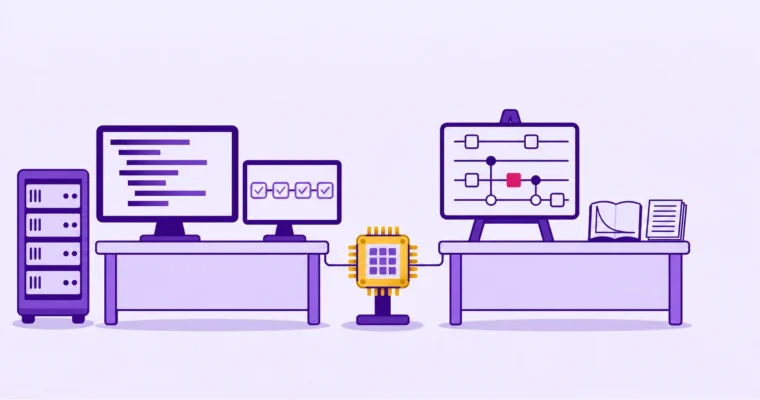
Control electronics engineers build the classical hardware that operates a quantum computer. They design the boards that generate each control signal and capture each measurement. Our November 14, 2026 snapshot has 87 electrical, RF, and control electronics listings from 26 employers.
Engineers from telecom, radar, and test equipment already design RF chains, converters, and FPGA logic. They have to learn how an error in the electronics becomes an error in a qubit. Employers mention a PhD in 22 of the 87 listings. Across all 805 technical listings on the board, they mention one in 366.
A listing is one advertisement on an employer’s careers site. We counted words in listing text. A mention of a PhD may be a requirement, a preference, or one route among several.
What the control layer does
Every hardware type needs this layer. The signals differ by type.
| Hardware type | Typical electronics tasks |
|---|---|
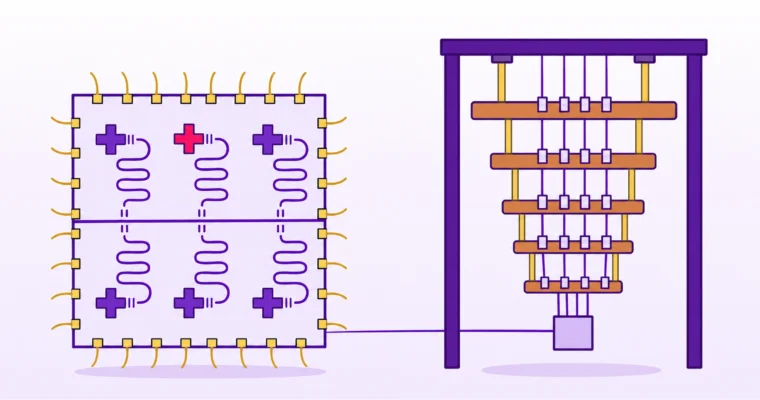
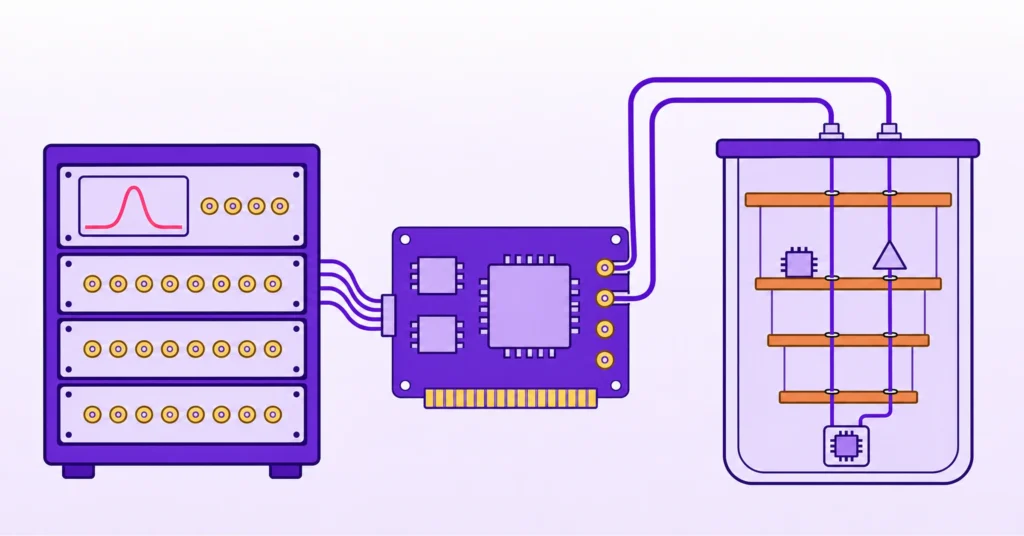
| Superconducting | Generate shaped microwave pulses and flux-control signals, and digitize the microwave readout signal |
| Silicon spin | Supply low-noise gate voltages and fast voltage pulses, add microwave drives where the design uses them, and read out the charge sensors |
| Trapped-ion | Supply the radio-frequency drive and electrode voltages that hold and move the ions, and drive the modulators that switch each laser beam |
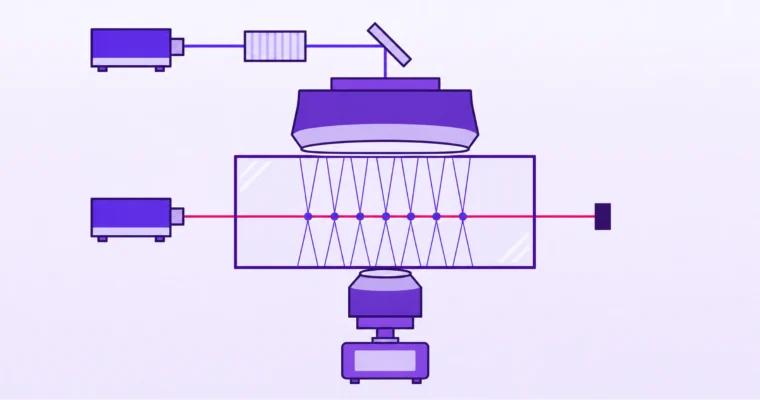
| Neutral-atom | Generate the radio-frequency tones that steer the optical tweezers, and time each laser pulse and camera exposure |
| Photonic | Read out single-photon detectors and drive fast optical switches |
Many systems use a field-programmable gate array (FPGA) to sequence the signals with nanosecond timing, alongside processors and custom chips. Converters turn the digital sequence into analog waveforms and turn the returning signals back into data.
Teams that run error correction need two more things from the electronics. The electronics must pass each round of measurements to a decoder. The decoder must keep up with that stream, or a backlog builds. When a later operation depends on a decoded result, the result must also arrive in time. Google reported both figures for a distance-5 memory in a paper in Nature. The error-correction cycle took 1.1 microseconds, and the real-time decoder returned results with an average latency of 63 microseconds. We describe the decoder roles in our error correction careers guide.
Engineers also want to move part of the control electronics inside the refrigerator. Fewer cables then run from room temperature to the qubits. Chips designed for that purpose are called cryo-CMOS. Cryo-CMOS engineers design and test CMOS circuits that work at cryogenic temperatures. Intel verified its Horse Ridge II control chip at 4 kelvin in 2020. IBM said in November 2026 that its latest cryogenic control chips match the gate performance of its room-temperature electronics.
A cryo-CMOS designer combines analog and mixed-signal design with device measurements at low temperature. A refrigerator can remove very little heat. The designer therefore works to a strict power budget. Rhonexum, a startup, raised US$1 million in equity and grants in March 2026 to build cryogenic electronics. Candidates should search for integrated circuit design, device modeling, and validation roles as well as the cryo-CMOS label.
The roles
We sorted the 87 listings by the words in their titles. A title can appear in more than one group.
| Group | Listings | Employers | Example titles |
|---|---|---|---|
| FPGA, firmware, and embedded | 27 | 18 | Senior FPGA Engineer (Oxford Quantum Circuits); FPGA Digital Design Engineer (Universal Quantum); Staff Firmware Engineer (PsiQuantum) |
| RF and microwave | 14 | 8 | RF Engineer (QuantWare); Senior RF Engineer – Electromagnetic Design & Simulation (Photonic Inc.) |
| Analog and mixed-signal | 7 | 5 | Analog Electrical Engineer (Quantinuum); Senior Electronics Engineer – Analogue/Mixed-Signal (Nu Quantum) |
| ASIC and silicon validation | 4 | 3 | ASIC Project Engineer (Quantinuum); Principal ASIC Verification Engineer (Atom Computing) |
The remaining titles are general ones such as Electrical Engineer, Electronics Engineer, and Hardware Engineer. Seven are engineering management titles.
FPGA and firmware engineers form the largest group. They write the logic that sequences pulses and captures measurements. That logic also passes data to the decoder. Employers name FPGA skills in 47 of the 87 listings and Verilog or VHDL in 25.
RF and microwave engineers design the radio-frequency (RF) signal paths. In a superconducting system they design the filtered and attenuated lines that take control signals to the chip and the low-noise amplifier chain that brings readout signals back. In an ion trap they deliver the high-voltage radio-frequency drive that confines the ions. Employers mention RF or microwave work in 52 of the 87 listings.
Analog and mixed-signal engineers design the converter stages and low-noise bias sources. Amplitude noise, phase noise, drift, and crosstalk in those circuits can each cause a qubit error. Employers mention low-noise design in 20 listings.
ASIC engineers design application-specific integrated circuits (ASICs) and are the smallest group. Quantinuum, Atom Computing, and IonQ each list ASIC or silicon validation roles. Employers mention ASIC or CMOS work in 11 of the 87 listings. Two silicon spin companies on the board, Quantum Motion and Equal1, build their qubits with CMOS manufacturing. They have 27 listings between them.
Employers ask for board-level design skills in all four groups. They name printed circuit board (PCB) design or a layout tool in 43 listings and Python in 44.
Who hires
Companies that build complete quantum computers have most of these listings.
| Employer | Listings |
|---|---|
| IonQ | 10 |
| Monarch Quantum | 9 |
| Quantinuum | 8 |
| Universal Quantum | 7 |
| PsiQuantum | 5 |
| Oxford Quantum Circuits | 5 |
Twenty other employers have between one and four listings each. We tag 25 of the 87 listings trapped-ion, 15 superconducting, 13 neutral-atom, five photonic, and two silicon spin. The other 27 have no hardware tag. Their employers supply several hardware types or build components.
The United States has 37 of the listings and the United Kingdom has 25. Employers mark 76 of the 87 on-site.
Three control-system suppliers are on the board: Quantum Machines with 66 listings, Qblox with 19, and Zurich Instruments with five. Those totals cover every function, and few of the listings are in board design. The largest groups are sales and customer engineering with 23 listings and product and program management with 16. Engineers who would rather diagnose a customer’s experiment than design a new board should look at the application and solutions roles these suppliers list.
Quantum Machines raised US$170 million in February 2025. The company said at the time that more than half of the companies developing quantum computers were its customers.
Posted salary ranges
Ten employers posted the 36 annual US dollar ranges we found on these listings.
| Group | Ranges | Median posted range | Median midpoint |
|---|---|---|---|
| All control electronics listings | 36 | US$159,500–202,500 | US$180,000 |
| Mid-level | 10 | US$135,000–182,000 | US$158,500 |
| Senior | 13 | US$140,000–190,000 | US$166,000 |
| Lead or principal | 12 | US$177,500–225,000 | US$200,000 |
| FPGA, firmware, and embedded titles | 11 | US$165,000–205,000 | US$182,500 |
We set the levels ourselves from each title. Oratomic posts one listing that is open to all experience levels at US$200,000–350,000, and we left it out of the level rows. Each level has 10 to 13 ranges, so treat these figures as an indication.
The median posted range pairs the median minimum with the median maximum. The median midpoint is the median of each listing’s own midpoint, so it need not fall halfway between the two. Employers describe most of these ranges as base salary, and a range is not an offer.
The median midpoint across all 541 annual US dollar ranges on the board was US$173,500 on November 14, 2026. The two groups have different employers, locations, and levels. Do not read the difference as a premium for electronics skills. We explain the method in our salary snapshot, which reports figures from November 12.
Moving in from another industry
Engineers from three industries have the most transferable experience.
- Telecom and wireless engineers already design RF chains, converters, and FPGA signal processing at similar frequencies.
- Radar and defense electronics engineers already build phase-stable, low-noise systems with strict timing.
- Test and measurement engineers already build arbitrary waveform generators and digitizers, which are the commercial products most similar to a qubit controller.
New hires from these industries need to learn how a qubit responds to a pulse and how noise in the electronics becomes an error in the computation. Candidates can prepare by learning the basics of one hardware type before they apply. We describe how each one works in our guides to superconducting hardware, trapped-ion engineering, and neutral-atom machines.
Bring evidence that a hiring manager can check. Good examples are an FPGA design with timing constraints and a testbench, the measured performance of an RF chain, or a mixed-signal design with documented noise and drift.
Candidates without a doctorate can read quantum careers without a PhD for the other role families in which few listings mention one. One of the 87 listings is marked remote.
Browse the open hardware roles on Quantum Careers.