Quantinuum’s Helios, launched in November 2025, holds 98 physical qubits, each a single barium-137 ion suspended in electric fields above a chip. Its two-qubit gates reach a fidelity of 99.921%, a figure Sandia National Laboratories and Quantinuum confirmed in a joint benchmarking study. Atomic physicists design the physics of a machine like that. Laser, optics, fabrication, vacuum, electronics, and software teams build and run it. In November 2026, posted salary ranges at Quantinuum and IonQ, the two trapped-ion employers with US ranges on Quantum Careers, put mid-level engineering and science roles at a median midpoint of US$155,000.
How a trapped-ion quantum computer works
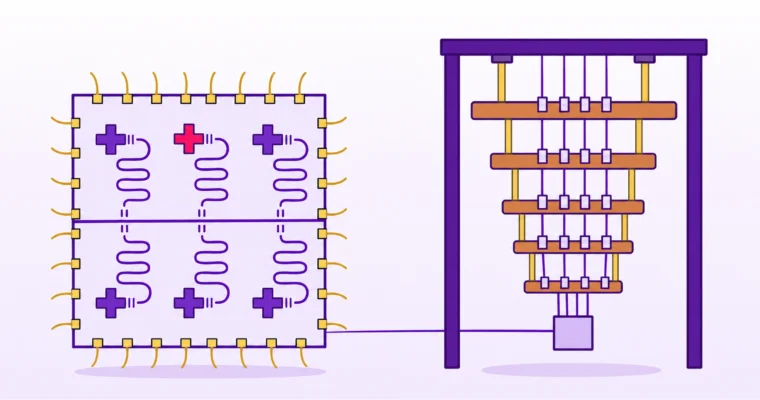
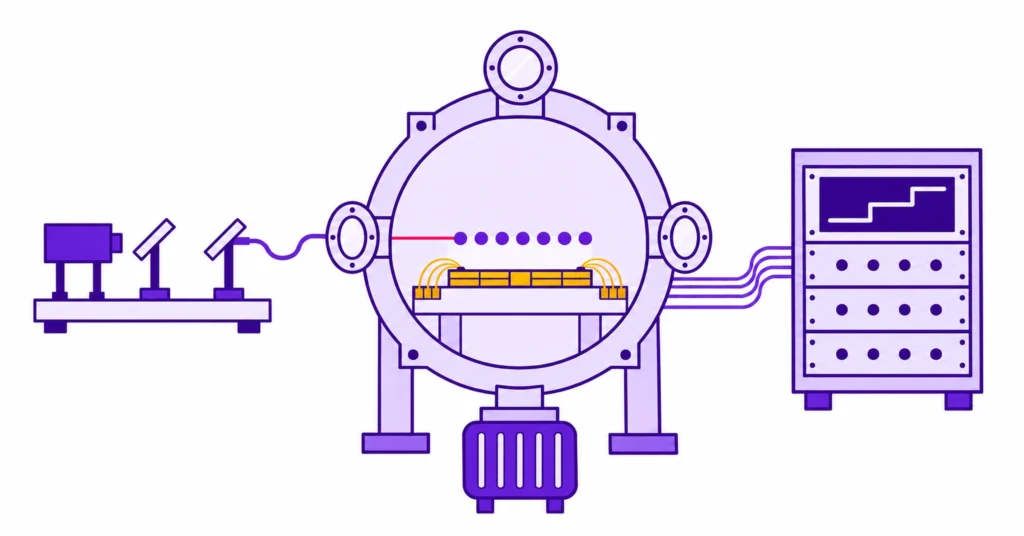
Each qubit is an ion, an atom stripped of one electron. Oscillating radio-frequency (RF) fields and static voltages on a set of electrodes hold the ions in an ultra-high vacuum, a short distance above the surface of a trap chip. Helios uses barium-137 ions as qubits and ytterbium ions to cool them. Quantinuum’s earlier H1 and H2 systems used ytterbium qubits.
IonQ, Quantinuum, and AQT built their systems around laser-driven gates. Oxford Ionics and eleQtron drive gates with microwaves and electronics instead, which Quantum Zeitgeist identifies as the field’s second technical camp. Oxford Ionics built its traps on silicon chips with integrated microwave antennae, which reduce the need for bulk laser systems. Lasers are still used for cooling, state preparation, and readout. IonQ acquired Oxford Ionics in 2025. In October that year it reported 99.99% two-qubit gate fidelity on an R&D prototype using the acquired electronic control technology.
Larger machines move ions around the chip. In the quantum charge-coupled device (QCCD) architecture Quantinuum uses, the control system changes electrode voltages to shuttle ions between storage, cache, and gate zones. Helios stores qubits in a ring and moves them through a junction to the zones where gates are applied. To read out a qubit, the machine shines a laser on the ion and collects the light it emits.
Announced targets for scale run well ahead of demonstrated results. Quantinuum reported a demonstration that encoded 48 error-corrected logical qubits in Helios’s 98 physical qubits. IonQ’s announced target is two million physical qubits by 2030. Hiring plans reflect both figures, but only the first has been demonstrated, in a specific experiment that Quantinuum reported.
The roles, layer by layer
Job titles at trapped-ion companies follow the hardware. The titles below come from listings open on Quantum Careers in November 2026.
Atomic and experimental physics
Atomic, molecular, and optical (AMO) physicists design and test the physics the machine depends on. They load ions into the trap and prepare and read out qubit states. They also characterize gates and build the error budget that shows engineers where errors come from. Current listings include an Atomic Source Physicist, an Integration AMO Physicist, and an Ion Transport Physicist. The ion transport role designs the voltage sequences that move ions between zones without heating them. Employers usually ask for a PhD in AMO physics or equivalent experimental experience.
Lasers, optics, and integrated photonics
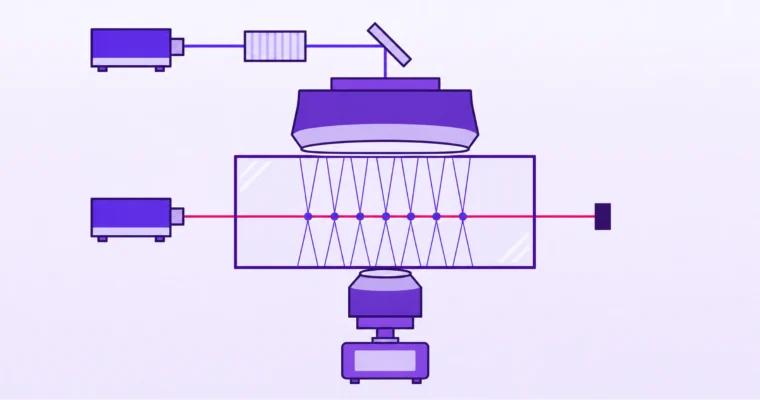
Laser-driven machines need lasers at several wavelengths for cooling, state preparation, gates, and readout. Each laser has to be stabilized in frequency and aligned precisely onto the ions. Quantinuum switched to barium partly because its qubits can be controlled with visible-spectrum lasers, which allow a more scalable laser architecture than the earlier ytterbium systems. Engineers in this group build and maintain the laser systems. They also design beam delivery and package optics for long-term stability.
Quantinuum is also moving light delivery onto the chip. Its current listings include photonic integrated circuit (PIC) design, metasurface design, and diffractive optics engineering. Each of those disciplines routes light to many ions without a separate table of free-space optics for each one. Engineers from telecom photonics, lidar, and semiconductor lithography have directly relevant experience.
Trap design and fabrication
A surface-electrode trap is a microfabricated chip. Engineers design it with semiconductor layout tools. Fabrication teams make it with lithography, deposition, and etching. Open roles include a Semiconductor Trap Fabrication Scientist, an Advanced Ion Trap Fabrication Scientist, a microelectromechanical systems (MEMS) layout and routing engineer, and semiconductor packaging engineers. The process steps are the same ones used for MEMS and semiconductor devices, so process engineers from those industries can move into trap fabrication with little quantum background.
Vacuum, cryogenic, and mechanical systems
The ions need ultra-high vacuum. Some designs also cool the trap to cryogenic temperatures. Mechanical engineers design the vacuum chambers, cryostats, and optical mounts that keep alignment stable over long periods. One current listing names the combination directly: a Mechanical Design Engineer for “Cryo, Optical, Vacuum Systems”. Experience with ultra-high vacuum hardware from semiconductor equipment or analytical instruments transfers directly.
Electronics, FPGA, and ASIC design
The trap needs an RF drive and many channels of precisely timed voltages to hold and move ions. The control system has to react in real time to measurement results. As machines grow, that control moves into custom electronics. Current listings include Analog Electrical Engineers, field-programmable gate array (FPGA) design engineers, and application-specific integrated circuit (ASIC) test and characterization engineers. IonQ’s listing for a Physicist in Ion Transport and Waveform Design combines physics with electronics design. Electronic qubit control replaces some of the optics with electronics, which increases demand for this group.
Software, calibration, and operations
Quantum compiler engineers translate programs into the gate and transport sequences a specific machine can run. Calibration engineers keep gate fidelities at their specified values as hardware drifts. Hardware operations engineers and deployment physicists keep systems available to customers, including systems installed at customer sites. Hardware technicians assemble and maintain the equipment. Many technician roles do not require a degree.
Who hires
The two trapped-ion companies with the most listings on Quantum Careers are Quantinuum, headquartered in Broomfield, Colorado, and Cambridge, UK, and IonQ, headquartered in College Park, Maryland. Quantinuum’s US listings on Quantum Careers are concentrated in Broomfield, with others in Brooklyn Park, Minnesota, and Albuquerque, New Mexico. IonQ’s are spread across College Park, Bothell, Boulder, and Oxford, where the Oxford Ionics team works.
The Quantum Insider’s 2026 survey of trapped-ion companies also lists AQT in Austria and eleQtron in Germany. Universal Quantum, a UK trapped-ion company, listed 33 roles on Quantum Careers on November 12, 2026, in Haywards Heath, Hamburg, and Singapore. None of them posted a salary range. Quantum Art in Israel builds trapped-ion systems as well. National laboratories, including Sandia, hire trapped-ion physicists and engineers, often into research roles. So do the university groups that developed the technology. Current listings are collected under trapped-ion roles.
What they earn
Quantinuum and IonQ together posted 101 annual US salary ranges for engineering, science, technician, and software roles carrying the trapped-ion tag on November 12, 2026. Sales, product, corporate, and intern listings are left out. At IonQ the tag also covers some roles in divisions outside trapped-ion computing, such as space and networking. Each range in the table is the median of the posted minimums and the median of the posted maximums. IonQ’s ranges are base salary, with bonus and equity on top. Quantinuum posts pay ranges, and for incentive-eligible roles it says the range includes the target bonus; its listings on Quantum Careers do not say which roles those are.
| Career level | Listings | Median range | Median midpoint |
|---|---|---|---|
| Mid-level | 42 | US$132,000–176,500 | US$155,000 |
| Senior | 26 | US$146,000–188,000 | US$166,000 |
| Lead or principal | 30 | US$160,500–214,000 | US$185,000 |
Only one director-level range fell in this group, so the table stops at lead or principal. Ranges for specific trapped-ion roles show how salaries vary by discipline at the same level.
| Role | Employer | Level | Posted range |
|---|---|---|---|
| Ion Transport Physicist | Quantinuum | Mid-level | US$148,000–185,000 |
| Physicist, Ion Transport and Waveform Design | IonQ | Mid-level | US$110,336–144,459 |
| Semiconductor Trap Fabrication Scientist | Quantinuum | Mid-level | US$147,000–197,000 |
| Advanced Electro-Optical Engineer | Quantinuum | Mid-level | US$131,000–176,000 |
| FPGA Design Engineer | Quantinuum | Mid-level | US$135,000–181,000 |
| Advanced Quantum Compiler Engineer | Quantinuum | Mid-level | US$138,000–173,000 |
| Senior Quantum Physicist | IonQ | Senior | US$132,000–198,000 |
| Senior PIC Design Engineer | Quantinuum | Senior | US$148,000–185,000 |
| Principal Mechanical Design Engineer, Cryo Vacuum Systems | Quantinuum | Lead or principal | US$183,000–210,000 |
| Hardware Technician | Quantinuum | Mid-level | US$66,000–105,000 |
Quantinuum also posted hourly rates for 11 internships, from US$22 to US$55 an hour, with photonic and optical design internships at the top. Our salary snapshot compares these figures with the rest of the quantum hardware market. Our guide to quantum compensation covers what to negotiate beyond base salary.
How to move into trapped-ion work
The most direct route is a PhD in experimental AMO physics. Trapped-ion companies hire many physicists straight from those research groups. The engineering roles draw from a wider pool.
- Optics and laser engineers from telecom, lidar, metrology, and semiconductor lithography. Name the wavelengths, laser types, and stability requirements you have worked with.
- Semiconductor and MEMS process engineers. Trap fabrication uses the same tools, and process ownership and yield work transfer directly.
- RF, analog, and FPGA engineers from defense electronics, test and measurement, and wireless infrastructure. Low-noise analog design and real-time control are the skills these roles call for.
- Mechanical and vacuum engineers from semiconductor equipment and analytical instruments.
- Software engineers with compiler, embedded, or high-performance computing experience.
- Technicians from semiconductor fabs, optics manufacturing, and laboratory operations.
Trapped-ion listings mix physics and engineering vocabulary. Our guide to decoding quantum job descriptions explains the terms. Our guide to quantum interviews covers what hardware teams test for.