On June 22, 2026, Executive Order 14412 required US federal agencies to move their high-value assets and high-impact systems to post-quantum cryptography (PQC) for key establishment by December 31, 2030. The order set December 31, 2031, as the deadline for digital signatures (White House, NIST). Four months later the US National Institute of Standards and Technology (NIST) finalized its transition plan, NIST Internal Report (IR) 8547, which deprecates quantum-vulnerable public-key algorithms such as RSA and elliptic-curve cryptography after 2030 and disallows them under NIST standards after 2035 (NIST). In the EU, the member states’ coordinated roadmap asks for national transition plans by the end of 2026 and migration of high-risk use cases by the end of 2030 (European Commission).
The White House, NIST, and the EU set those deadlines without waiting for a cryptanalytically relevant quantum computer (CRQC), and no one knows when one will exist. The deadlines follow from two facts. Data encrypted today can be recorded now and decrypted later, and replacing cryptography across a large organization takes years. Five years ago, few employers outside research labs and a handful of vendors advertised a job titled “Post-Quantum Cryptography Engineer.” Today post-quantum cryptography careers are forming across banks, telecom operators, cloud providers, government agencies, and their contractors. These employers are building teams to do this work and hiring for roles that combine applied cryptography with enterprise IT.
Why migration needs a team
National Security Memorandum 10 in May 2022 directed federal agencies to inventory their quantum-vulnerable cryptography, and the Quantum Computing Cybersecurity Preparedness Act, signed that December, required agencies to plan their migration (Congress.gov). The first finding in most organizations was that nobody knew where all of their cryptography was. Public-key algorithms are embedded in Transport Layer Security (TLS) endpoints, virtual private networks (VPNs), code-signing pipelines, hardware security modules (HSMs), identity systems, firmware, and third-party products, usually with no central record.
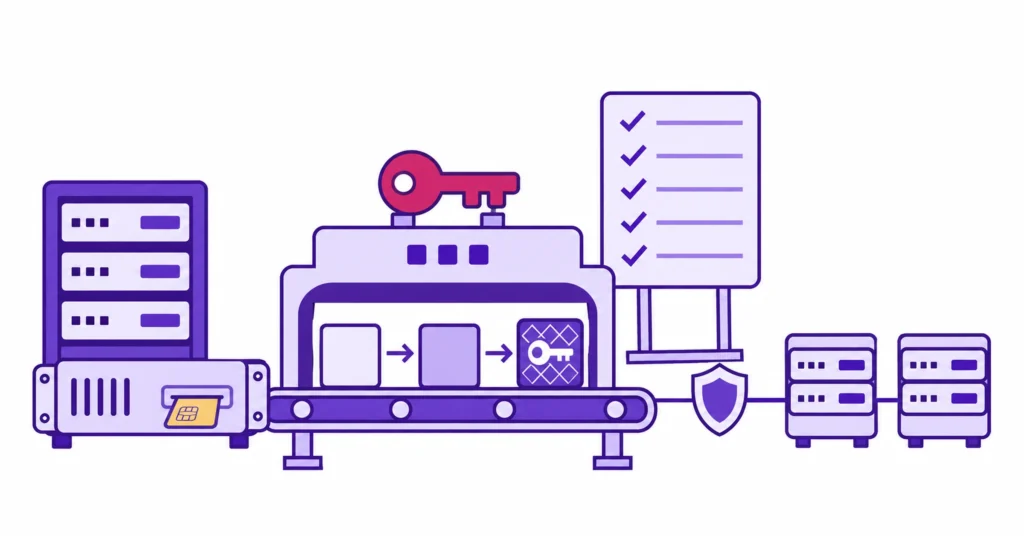
A migration program therefore has three jobs. It has to find the cryptography and rank it by risk. It has to replace it with the NIST standards, ML-KEM (formerly CRYSTALS-Kyber) for key establishment and ML-DSA (formerly CRYSTALS-Dilithium) and SLH-DSA (formerly SPHINCS+) for signatures, often in hybrid modes alongside classical algorithms during the transition (NIST FIPS 203, FIPS 204, FIPS 205). And it has to leave the organization able to change algorithms again without a second multi-year project, a property usually called crypto-agility.
Executive Order 14412 also requires each federal agency to designate a PQC migration lead (White House), so the program-level role now exists by order in the US government. Below that lead, four roles recur across job listings in the field.
Post-quantum cryptography engineer
What the role does. The PQC engineer implements and tests the new algorithms in the organization’s systems. That covers prototyping hybrid key exchange in TLS and VPNs, evaluating libraries and HSM firmware that support ML-KEM and ML-DSA, benchmarking performance, and writing the migration playbooks that application teams follow. In a large organization, this engineer often delivers the first production deployment and becomes the person every later team consults.
Skills. Applied cryptography and solid software engineering. Engineers need to understand both classical algorithms and the lattice- and hash-based schemes that replace them. They also need to know the libraries in use, such as OpenSSL, BoringSSL, and the Open Quantum Safe project’s liboqs. Listings commonly ask for C, C++, Rust, or Python, along with working knowledge of public key infrastructure (PKI), key management, and HSMs, and the ability to read protocol specifications from the Internet Engineering Task Force (IETF). Employers hiring for research-heavy roles favor a master’s degree or PhD. For implementation roles, a public contribution to an open-source PQC project often counts for as much.
Interview questions to expect.
- “How would you make our external TLS connections quantum-safe?” A strong candidate starts with an inventory of endpoints and libraries and proposes hybrid key exchange (a classical algorithm combined with ML-KEM). With hybrid key exchange, clients without PQC support keep working. The candidate then plans a phased rollout with performance testing at each stage.
- “We have thousands of internal applications. How would you find the ones using quantum-vulnerable cryptography?” Expect to describe automated discovery: scanning code repositories for cryptographic API calls, scanning networks for TLS configurations, pulling certificate inventories, and following up with system owners for anything embedded or custom.
- “Explain ML-KEM to our developers in plain terms.” PQC engineers spend a large share of their time teaching. The interviewer wants to hear whether you can explain why a lattice problem is believed hard for quantum computers without losing the audience.
Cryptographic inventory analyst
What the role does. The inventory analyst builds and maintains the organization’s record of where cryptography is used. Each entry records the algorithms and key lengths a system uses and the certificates it holds, with their expiry dates. It also records the vendor that supplies the system, how sensitive its data is, and how long that data has to stay confidential. The analyst then ranks systems for migration and reports progress to leadership. The record is increasingly kept as a cryptographic bill of materials (CBOM), which the CycloneDX standard supports alongside the software bill of materials.
Skills. Enough cryptography to recognize what each system is doing, plus the habits of an IT asset manager and a risk analyst. Scripting for discovery helps, as does familiarity with certificate management platforms and risk frameworks. Communication is a large part of the job. The analyst interviews dozens of system owners, most of whom did not ask for the meeting. The findings then go to leadership in business terms: which customer data is exposed, and by when it has to be protected. Many people in this role come from security architecture, audit, or risk work.
Interview questions to expect.
- “Walk us through a cryptographic inventory for an enterprise with several hundred applications.” Good answers combine automated discovery (certificate stores, cloud key vaults, code and network scanning) with structured interviews of system owners, and end with a central catalog that someone keeps current.
- “Once we know which systems are vulnerable, how would you decide what to migrate first?” Expect to weigh how long the data must stay confidential, whether the system faces the internet, how hard it is to change, and what regulators or customers require. Systems protecting sensitive data that must stay confidential for many years go first. An adversary who records that data today can decrypt it once a CRQC exists.
- “What would you do about vendor products that use vulnerable cryptography?” A strong candidate proposes asking each vendor for its PQC roadmap and adding PQC requirements to contracts and renewals. Where a vendor has no roadmap, the candidate plans to replace the product.
DevSecOps engineer for crypto-agility
What the role does. This engineer builds PQC into the delivery pipeline and automates the rollout of cryptographic changes. Typical work includes adding cryptographic scanning to continuous-integration builds, enforcing an approved-algorithm list, automating certificate issuance and rotation, and using infrastructure-as-code to stand up test environments where developers can try PQC algorithms. The engineer also deploys new keys and certificates to every system that needs them without causing an outage.
Skills. Strong automation and scripting (Python, Bash, Go), cloud key-management services, continuous-integration tooling, containers and Kubernetes, and configuration management. On the security side, a working knowledge of PKI and TLS configuration and experience integrating security scanners into pipelines. Many people come to this role from DevOps or site reliability engineering after developing an interest in cryptography.
Interview questions to expect.
- “How would you add a check for outdated cryptography to our build pipeline?” Expect to describe a scanner that runs on every build, fails it or raises an alert when a disallowed algorithm appears, and draws on an algorithm policy that the security team can update as standards change.
- “How would you roll out post-quantum certificates to hundreds of microservices?” A good answer covers central certificate management, staged deployment, and compatibility testing. PQC certificates and signatures are much larger than their classical equivalents. An ML-DSA signature is roughly 2.4 to 4.6 kilobytes depending on the parameter set (FIPS 204), against about 64 bytes for an Elliptic Curve Digital Signature Algorithm (ECDSA) P-256 signature. That difference increases handshake sizes and affects some network equipment.
- “How would you integrate an HSM that supports post-quantum algorithms?” Expect to discuss firmware upgrades, client library and PKCS#11 changes, and testing the new key types before production use.
Quantum-safe security architect
What the role does. The architect designs the organization’s target cryptographic architecture and the sequence for reaching it. That includes choosing which algorithms and parameter sets to use for each purpose, deciding where hybrid modes are needed, designing for crypto-agility through central cryptographic services or configuration-driven algorithm choice, and writing the standards and playbooks other teams follow. In consulting firms and vendors, architects in the same role guide clients through discovery, planning, and migration.
Skills. Usually 10 years or more in security architecture, with direct experience of a large cryptographic change such as a PKI rebuild or the move from SHA-1 to SHA-2 certificates. The architect needs to understand how algorithm choices play out in real systems, to follow the standards work at NIST and the IETF, and to know what the organization’s regulators expect. The architect also reports to the CISO and sometimes the board. Both expect the architect to explain risk and trade-offs clearly.
Interview questions to expect.
- “How would you design our systems so we can change algorithms again without another multi-year program?” Expect to talk about abstraction layers, central cryptographic services, configuration-driven algorithm selection, and keeping the inventory current.
- “Walk us through a migration playbook for one enterprise application.” A strong answer moves from inventory to algorithm selection, a hybrid test deployment, performance testing, a rollback plan, and a staged production cutover.
- “How would your algorithm choices differ for IoT devices and data-center servers?” Expect to compare key and signature sizes, computational cost, and how firmware is signed and updated. NIST SP 800-208 standardizes stateful hash-based signatures, LMS and XMSS, which device makers can use to sign firmware for devices that stay in service for many years, when the signing system tracks state reliably (NIST).
How to move into a PQC role
Most people in these roles came from classical security work. PKI administrators, security architects, and engineers from software security and DevOps can all move across. A few steps make the move credible to employers:
- Learn the standards directly. Read FIPS 203, 204, and 205 and NIST IR 8547. Most interviewers will expect you to know the new algorithm names and the transition dates.
- Build something public. Configure a hybrid TLS connection with an open-source library, write a script that finds RSA and elliptic-curve certificates across a network, or contribute to an open-source PQC project.
- Use the inventory you already have access to. If your current employer has started a PQC program, volunteering for discovery work is the fastest way to gain experience that appears on a résumé.
Employers in the US federal market also look for candidates who can obtain a security clearance. Our guide to visas, relocation, and security clearances explains how clearance requirements work.
If you lead security, check whether someone in your organization already owns cryptographic migration. If nobody does, that is the first role to fill. You can browse current quantum security and PQC openings, read our guide to how employers in this field set pay, or talk to our executive search team about senior cryptography and architecture hires.
First published November 3, 2025. Revised November 10, 2026: updated for Executive Order 14412 and the final NIST IR 8547, algorithm names changed to the NIST standard names, and quotations from job listings that could not be traced were removed.