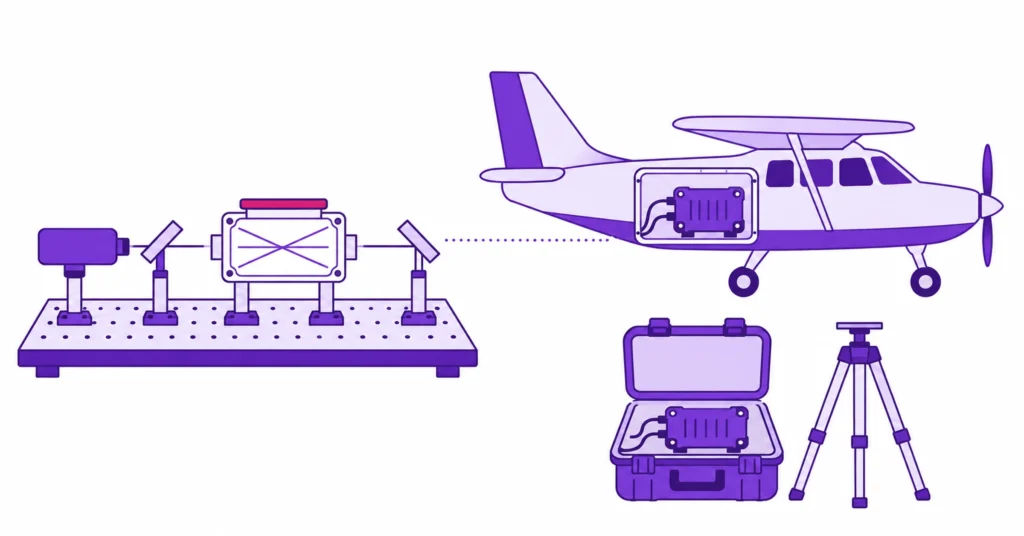
In a 2022 paper in Nature, researchers at the University of Birmingham reported using a quantum gravity gradiometer outdoors to locate a tunnel buried beneath a road, a measurement that conventional gravity sensors struggle to make because ground vibration swamps the signal (Nature). In May 2024 a consortium led by Infleqtion, with BAE Systems and QinetiQ, flew an optical atomic clock and elements of a quantum inertial sensor on a test aircraft in the UK (QinetiQ). In August 2025, the US Space Force launched the eighth mission of its X-37B spaceplane (US Space Force). The payload includes what the service called the highest-performing quantum inertial sensor ever used in space (US Space Force).
Each of those teams took a quantum instrument further from the optical table and needed engineers who are not physicists. Quantum sensing is the part of quantum technology closest to field deployment, and quantum sensing careers have shifted accordingly, from research positions toward systems, photonics, electronics, test, and field application roles.
What a quantum sensor does
A quantum sensor uses a quantum system, such as a cloud of cold atoms, an atomic vapor, a trapped ion, or a defect in a diamond crystal, as its sensing element. Those systems respond in a precisely known way to time, acceleration, rotation, gravity, or magnetic fields, and lasers or microwaves read out the response. Because every atom of a given species behaves identically, quantum sensors can be very stable and drift less than classical instruments built from springs, coils, or vibrating structures.
The difficulty is that the same sensitivity makes them vulnerable to vibration, temperature changes, and electromagnetic interference. Moving a sensor from a laboratory to a vehicle mostly means protecting its performance from those disturbances, and companies hire engineers to do that work. The Robust Quantum Sensors (RoQS) program of the US Defense Advanced Research Projects Agency (DARPA) exists specifically to build quantum sensors that keep their performance on moving military platforms (DARPA), and its first phase tests compact sensors aboard a government-provided helicopter, chosen because of its vibration and electromagnetic noise (Intelligence Community News).
The main sensor types
Atomic clocks
The most mature quantum sensors. Atomic clocks already provide timing for satellite navigation, telecom networks, and financial systems. Optical atomic clocks are more precise still, and the work now focuses on making them small and robust enough to leave the lab. Clock work draws on laser and optics engineering, vacuum systems, microwave electronics, and frequency metrology.
Gravimeters and gravity gradiometers
These use atom interferometry: lasers split and recombine the matter waves of free-falling cold atoms, and gravity shifts the resulting interference pattern. Applications include surveying for voids, tunnels, and buried infrastructure, monitoring groundwater and volcanoes, and gravity-map navigation. Teams need atom-optics specialists and geophysical data analysts alongside laser, mechanical, and vibration-isolation engineers.
Magnetometers
Optically pumped magnetometers use atomic vapors whose spins respond to magnetic fields, and nitrogen-vacancy (NV) centers in diamond sense fields at very small scales. Applications range from mineral exploration and infrastructure inspection to magnetoencephalography, the measurement of brain activity, using wearable sensors that avoid the cryogenic cooling older systems need. Skills include optics, atomic physics, radio-frequency (RF) engineering, and signal processing.
Inertial sensors
Cold-atom accelerometers and gyroscopes measure motion through atom interferometry. Combined into an inertial measurement unit, they could let aircraft, ships, submarines, and spacecraft navigate without satellite signals for longer than conventional inertial systems allow. This is the focus of the UK’s National Quantum Strategy mission for quantum navigation systems on aircraft by 2030 (UK Government).
Other techniques, including quantum-enhanced imaging and lidar, remain largely experimental. Superconducting quantum interference devices (SQUIDs), an older form of quantum sensor, have been used in medicine and materials testing for decades.
Roles in quantum sensing
Many of the roles below are open to engineers with bachelor’s or master’s degrees. Research scientist posts usually ask for a PhD, and senior roles at national laboratories often do.
Research scientist or R&D engineer. Designs and improves the sensing physics: reducing noise in an atom interferometer, testing new diamond materials, or extending a clock’s stability. A background in physics or electrical engineering with optics, atomic physics, vacuum, or RF experience is typical.
Systems engineer. Turns a sensor into a product that works on a platform. That means integrating lasers, vacuum hardware, control electronics, power, and firmware into a package that meets size, weight, and power limits, and connecting the sensor to the navigation or survey system it serves. Engineers from aerospace, automotive, or defense navigation systems move into this role with the least retraining.
Photonics and laser engineer. Most quantum sensors are optical instruments. Photonics engineers lock lasers to atomic transitions and design compact optical assemblies and fiber delivery. In production, they also assemble optical subsystems. Experience in telecom photonics or industrial lasers transfers directly.
Electronics, RF, and embedded engineer. Builds the microwave sources, low-noise amplifiers, field-programmable gate array (FPGA) timing and control systems, and firmware that run the sensor and read out its signal. Engineers from radar, instrumentation, or semiconductor test are well matched.
Data and software engineer. Turns sensor output into usable measurements: filtering noise, fusing quantum and classical sensor data, and building the software customers use. Python, signal processing, and domain knowledge such as geophysics or navigation matter more here than quantum physics.
Manufacturing and test engineer or technician. Builds, calibrates, and tests units as companies move from prototypes to small-batch production, and designs automated test equipment. Precision assembly, optics alignment, vacuum, and cleanroom experience are the core skills, and some employers recruit technicians with two-year technical degrees.
Field application specialist. Deploys sensors with customers, calibrates them on site, trains users, and helps interpret results. A geophysicist who learns the instrument, or a navigation engineer who knows the platform, often has the strongest profile for this role.
Typical job titles include quantum sensing engineer, atomic clock engineer, laser systems engineer, systems integration engineer, quantum hardware technician, field application scientist, and quantum metrology specialist.
Who hires
Quantum sensing employers fall into four groups. Specialist sensor companies, many of them university spinouts, build clocks, gravimeters, magnetometers, and inertial units. Defense and aerospace prime contractors integrate quantum sensors into navigation and detection systems, often under programs such as RoQS. National metrology institutes such as the National Institute of Standards and Technology (NIST) in the US, the National Physical Laboratory (NPL) in the UK, and the Physikalisch-Technische Bundesanstalt (PTB) in Germany maintain time and measurement standards and develop next-generation sensors. And universities and national laboratories run the research programs that seed new companies.
Defense work often requires a security clearance and, in some countries, citizenship. Our guide to visas, relocation, and security clearances covers how those requirements work, and our Quantum Talent Map shows how sensing hiring compares with computing and communications.
How to move into quantum sensing
Start from your current skills. Optics and laser experience applies directly to most sensors. RF and microwave experience applies to atomic state control and readout. Mechanical engineers with precision design experience work on vibration isolation and packaging. Embedded engineers build the control and data acquisition systems. Many sensing job listings ask for computer-aided design (CAD), printed circuit board (PCB) design, Python, or LabVIEW before they mention quantum physics.
Learn the physics of one sensor type well. Employers expect you to understand how the instrument you would work on operates: how an atom interferometer measures acceleration, or how an optically pumped magnetometer reads out spin. A university course in atomic physics or a short professional course covers most of what an engineering role needs, and employers typically teach the device-specific details on the job.
Build something. A Michelson interferometer, a laser frequency lock, or a magnetometer readout circuit built at home or at work gives you concrete material for an interview.
Use your domain knowledge. Sensor companies need people who understand the problem a customer is trying to solve. Surveyors, geophysicists, and engineers who work in navigation or on medical devices bring knowledge that a physics team usually lacks.
Current openings are listed under quantum sensing on Quantum Careers, with related hardware roles under enabling technologies. For a wider view of routes in without a doctorate, see our guide to quantum careers without a PhD.
First published November 1, 2025. Revised November 10, 2026: claims and quotations that could not be traced to a source were removed, and recent field demonstrations were added with sources. Updated November 11, 2026: the X-37B sentence now cites the US Space Force’s own announcements.