More than half of roughly 5,000 quantum job postings worldwide from 2022 to 2023 required no more than a bachelor’s degree, according to an analysis by the Chicago Quantum Exchange reported in Physics Today. In the same article, Celia Merzbacher, executive director of the Quantum Economic Development Consortium (QED-C), said that people with an undergraduate or master’s degree and “a little bit of quantum under your belt” would be well qualified for many positions.
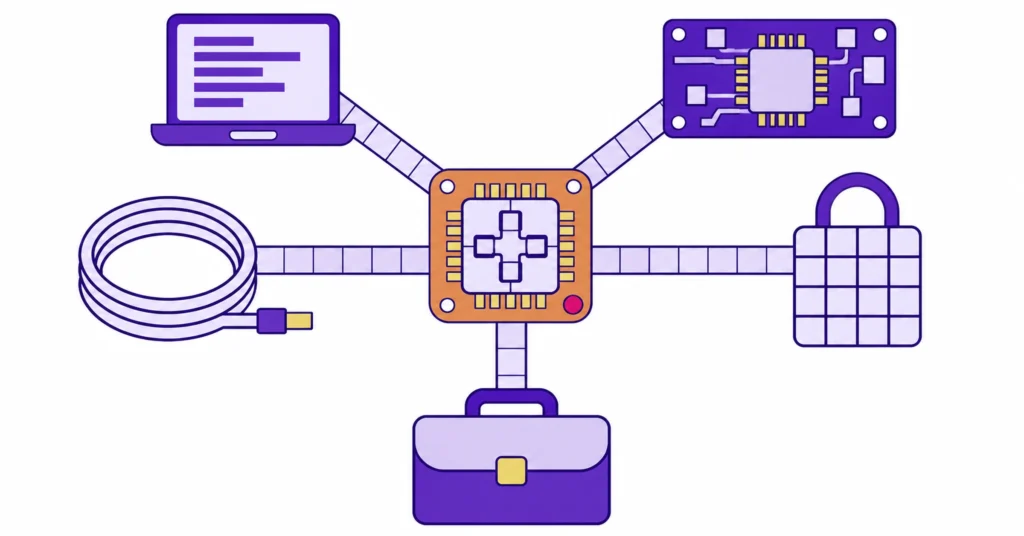
Building a quantum computer, a quantum network, or a field-ready sensor is mostly engineering: microwave and optical systems, cryogenics, control electronics, firmware, software, manufacturing, and security. Physicists design the core, and engineers, developers, and technicians build and run everything around it. If your background is in software, electrical or mechanical engineering, photonics, high-performance computing (HPC), embedded systems, or cybersecurity, you already have most of what many quantum roles require. You can usually learn the remainder on the job or through targeted study.
This guide maps quantum careers without a PhD: the main areas of quantum technology, the roles in each that are open without a doctorate, and how to move in. It draws on PostQuantum.com’s guide to quantum careers that don’t require a PhD.
Quantum computing software and algorithms
Quantum computers need a full software stack, from control firmware up to compilers, cloud services, and applications. These roles suit computer scientists, software engineers, and HPC specialists.
Typical titles: quantum software engineer, quantum compiler engineer, quantum cloud engineer, hybrid workflow developer, quantum applications engineer. Current software and algorithm openings.
Quantum software engineer
Builds the libraries, compilers, software development kits (SDKs), and cloud services that let people program quantum hardware. Strong Python and C++ and good engineering practice, such as testing, code review, and continuous integration and delivery (CI/CD), are the main requirements. Familiarity with an SDK such as Qiskit, Cirq, or PennyLane and with the linear algebra behind quantum circuits can be learned through online courses. Many people in these roles have a bachelor’s or master’s degree in computer science.
Algorithm and application developer
Applies known quantum algorithms to problems in optimization, chemistry, or machine learning, usually in hybrid workflows that combine quantum and classical computing. For research on new algorithms, employers often ask for a PhD, but application roles are open to strong master’s graduates and experienced data or computational scientists who learn the quantum basics.
Hybrid and HPC integration engineer
Connects quantum processors to classical supercomputers and cloud platforms: schedulers, APIs, workflow tools, and error handling. Experience in distributed systems, cloud infrastructure, or GPU programming transfers directly, and no quantum theory beyond the basics is needed.
Quantum computing hardware and engineering
Turning a laboratory prototype into a reliable machine needs engineers from electrical, mechanical, materials, and optical disciplines. Many hardware employers hire strong engineers without prior quantum experience and train them on the specifics.
Typical titles: hardware engineer, cryogenic systems engineer, radio-frequency (RF) control engineer, photonics engineer, test and reliability engineer, lab technician. Current hardware openings, and related roles in enabling technologies.
Hardware engineer
Designs, builds, and maintains the processor and the systems around it: fabrication, packaging, microwave control electronics, cryogenic systems, and vacuum hardware. Analog and RF circuit design, lab instrumentation, and semiconductor process experience all transfer well.
Cryogenic and microwave systems engineer
Designs the refrigeration, shielding, filters, amplifiers, and coaxial wiring that keep superconducting qubits cold and quiet. Thermal, mechanical, and RF engineers can do this work with little quantum background.
Photonics and laser engineer
Trapped-ion and neutral-atom computers, quantum networks, and many sensors depend on lasers and optics. Engineers stabilize lasers, align optical systems, route fiber, and design photonic integrated circuits. Telecom photonics experience transfers directly.
Control and firmware engineer
Programs the field-programmable gate arrays (FPGAs) and real-time systems that generate nanosecond-scale pulses, run feedback, and read out qubits. Embedded, controls, and signal-processing engineers are well matched.
Hardware technician
Assembles, tests, and operates quantum hardware: soldering, wiring, maintaining cryostats and vacuum pumps, swapping chip packages, and running calibrations. These roles are open to people with associate’s degrees or equivalent hands-on experience, and employers value careful manual work and reliability.
Quantum communications and networking
Quantum key distribution (QKD) and early quantum networks need people who combine photonics with telecom networking.
QKD hiring is concentrated in national programs, telecom operators, and equipment vendors, and security agencies in the US and Europe favor post-quantum cryptography for most uses. Our guide to quantum communications careers explains the market. Current communications openings.
Quantum network or QKD engineer
Designs and deploys QKD links over fiber or free-space optics, integrates them with existing encryption equipment, and keeps them running. Fiber-optic, optical networking, and RF communications engineers have the core skills, and protocol specifics such as BB84 can be learned on the job.
Protocol and test specialist
Tests QKD devices for interoperability and known attacks and integrates them with classical encryption. Network security and telecom test experience applies, though employers usually ask for a higher degree for theoretical work on security proofs.
Photonics manufacturing
Builds lasers, single-photon detectors, and photonic chips for communication systems. Photonic fabrication and precision optical assembly experience is in demand.
Quantum sensing and metrology
Quantum sensing is the area closest to commercial deployment, with atomic clocks, gravimeters, magnetometers, and inertial sensors moving into aircraft, vehicles, and hospitals.
Our quantum sensing careers guide describes the roles in detail. Current sensing openings.
Sensor R&D engineer
Helps build and test prototypes: electronics, firmware, optics, vacuum systems, and data acquisition. Employers prefer a PhD for some research roles, but many engineering positions are open at bachelor’s and master’s level.
Field application specialist
Deploys sensors with customers, calibrates them on site, and turns their readings into results. Geophysicists and navigation or medical device engineers who learn the instrument are often the strongest candidates.
Manufacturing and test
As sensor companies move to small-batch production, they need technicians and test engineers with precision assembly and calibration experience.
Post-quantum cryptography and security
Post-quantum cryptography (PQC) is the largest area of quantum-related work that involves no quantum hardware at all. Every organization using public-key cryptography has to migrate to PQC. The US National Institute of Standards and Technology (NIST) published the first standards in August 2024, ML-KEM (formerly CRYSTALS-Kyber), ML-DSA (formerly CRYSTALS-Dilithium), and SLH-DSA (formerly SPHINCS+) (NIST), and in October 2026 it finalized a plan that deprecates RSA and elliptic-curve algorithms after 2030 (NIST).
Employers include banks, telecom operators, cloud providers, government agencies and contractors, security vendors, and consultancies. Our PQC careers guide covers these roles and interview questions in detail. Current quantum security and PQC openings.
PQC engineer
Implements the new algorithms in libraries, protocols, products, and firmware. Employers screen mainly for strong classical cryptography and software skills. Research cryptographers often need an advanced degree, but implementation roles are open to experienced engineers with a bachelor’s degree.
Quantum security analyst or consultant
Inventories where vulnerable cryptography is used, ranks systems by risk, and plans the migration. Security architecture, risk assessment, and audit experience transfer directly.
Quantum-safe network engineer
Deploys PQC-enabled virtual private networks (VPNs), Transport Layer Security (TLS), and certificates across an organization’s network, usually with heavy automation.
Product, business, and other roles
Quantum companies also hire product managers, technical writers, solutions engineers, sales and business development staff, program managers, and operations specialists. These roles need enough technical understanding to talk credibly with engineers and customers, but not a doctorate. Listings for them appear under quantum-adjacent roles.
How to move in
Build on your strongest skill. Choose the quantum area that draws most directly on your current expertise: software engineers toward compilers and cloud platforms, RF engineers toward control hardware, network engineers toward QKD or PQC migration, embedded engineers toward control firmware.
Add the quantum knowledge your target role needs. For software roles, that means quantum circuits, linear algebra, and one SDK. For hardware roles, the operating principles of the modality you would work on. For security roles, the NIST PQC standards and migration timelines. University online courses and vendor documentation cover most of this.
Do a visible project. A small simulator, a contribution to an open-source quantum or PQC project, a hybrid workflow on a cloud quantum service, or a lab build gives you something concrete to discuss in interviews.
Read listings closely. Many quantum listings ask for more than the role needs. Our guide to decoding quantum job descriptions shows how to tell the core requirements from the wish list. A second guide, on quantum job interviews, sets out what to expect at each type of employer.
Quantum employers need people who can build devices, write reliable code, integrate systems, and run projects. Most quantum roles do not require a PhD. Browse current quantum roles to see what employers are asking for today.
First published November 2, 2025. Revised November 10, 2026: statistics are now sourced, untraceable quotations and anecdotes were removed, references to companies that have since closed or changed direction were updated, and PQC timelines were brought up to date.