Quantum job descriptions often combine terms from physics, microwave engineering, software, and cryptography on a single page. “Experience with FPGA-based pulse control, noise-aware compilation, and QEC” describes a specific job, but a capable engineer from a neighboring field can read it and conclude, wrongly, that it is out of reach. Quantum roles are interdisciplinary, and employers often list every skill the team touches rather than what one person will do each day.
This guide shows how to read those listings: identify the role type first, translate the terms, match your experience to them, and ask the questions that remove the remaining doubt. A glossary of the most common terms closes the article.
Start by identifying the role type
Most quantum listings follow the familiar structure of responsibilities, required qualifications, and preferred skills. The first job is to work out which layer of the technology the role belongs to. How to read every other requirement in the listing depends on that layer.
Hardware engineering
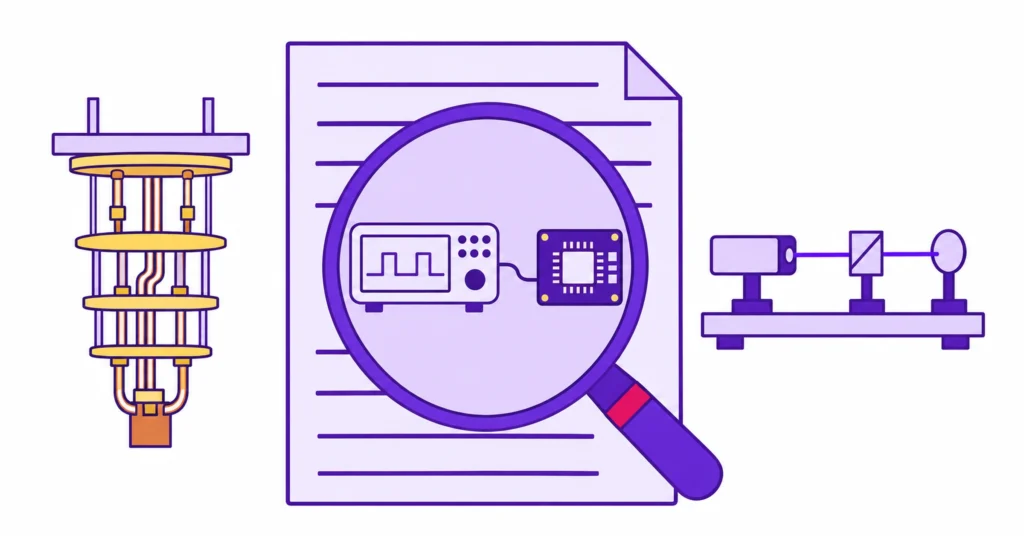
These roles build and run the physical quantum processor and its control systems. Listings mention cryogenics and dilution refrigerators, microwave and radio-frequency (RF) electronics, and lasers and optics for trapped-ion and neutral-atom systems. They also name the FPGAs and custom electronics that generate and read qubit signals. A phrase like “RF chain calibration” or “cryogenic microwave integration” means you will tune analog signal chains and work with cooling hardware.
Software development
These roles write the tools and code that run on quantum hardware or simulate it. Listings name software development kits (SDKs) such as Qiskit, Cirq, or PennyLane, and mention compilers or transpilers. “Noise-aware compilation” means mapping circuits onto a real device while accounting for its error rates. Engineers in these roles work in the software layers above the qubit hardware and usually collaborate closely with physicists.
Systems engineering
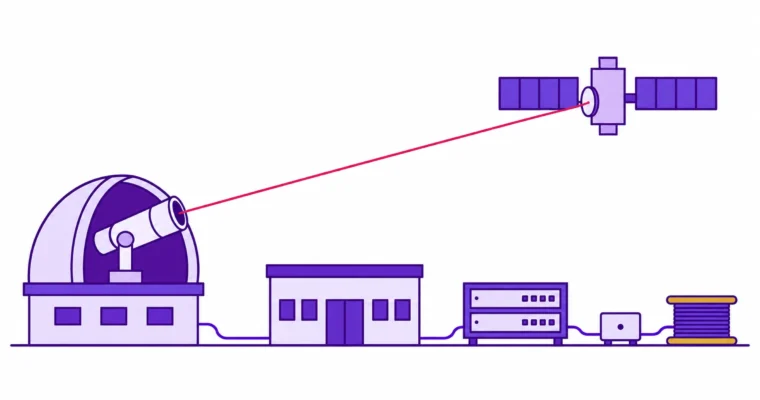
These roles connect hardware and software into a working system. Listings mix vocabularies, such as “qubit control integration” alongside “cloud deployment.” In quantum communications, a phrase like “QKD stack integration” means working on a quantum key distribution system from the optical hardware through to key management software.
Research
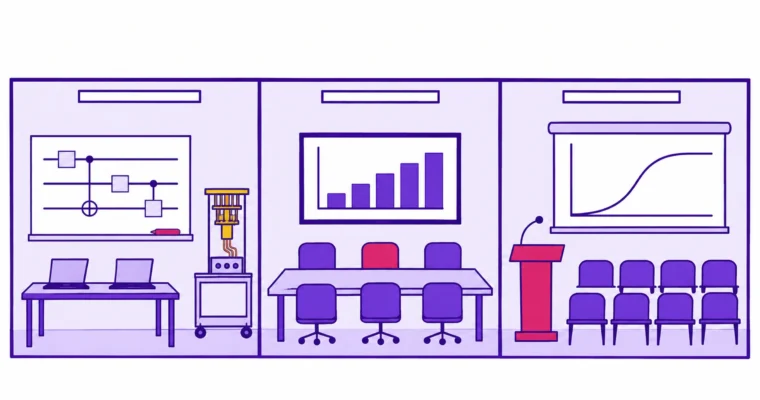
Research listings emphasize publications, new techniques, and topics such as quantum error correction (QEC) or new algorithms for a named application. They often ask for a PhD and may describe the background broadly, such as “physics, mathematics, or computer science,” because the hiring team wants adaptable problem-solvers.
Product and field roles
Product managers translate between customers and engineers, so listings ask for enough technical depth to discuss roadmaps credibly. Field application engineers and solutions architects deploy systems and support customers. “Travel to customer sites” or “training users” marks a field role. The technical requirements follow the product: optics for a photonic device, DevOps for a cloud service.
The terms, translated
Quantum error correction (QEC)
QEC protects quantum information by encoding one logical qubit across many physical qubits. With that encoding, errors can be detected and corrected faster than they accumulate. A listing that mentions QEC signals work on fault-tolerant systems. Research roles expect knowledge of codes such as the surface code. Engineering roles may involve real-time decoding, which runs on FPGAs or custom chips. When a listing or an article quotes a qubit count, check whether it means physical or logical qubits. The two differ by orders of magnitude.
Control electronics: AWGs, DACs, and FPGAs
Arbitrary waveform generators (AWGs) and digital-to-analog converters (DACs) produce the precisely shaped pulses that manipulate qubits. Field-programmable gate arrays (FPGAs) run real-time control and feedback. A requirement such as “experience with FPGA-based qubit control” means you will build or program the electronics between software instructions and the qubits. Engineers from radar, communications, and test instrumentation often have most of what these roles need.
Cryogenics and dilution refrigerators
Superconducting qubits and some sensors operate at millikelvin temperatures. A dilution refrigerator reaches those temperatures using a mixture of helium-3 and helium-4. “Experience with dilution refrigerators” means you can operate and maintain the cryogenic systems that house the processor. Experience with any low-temperature or ultra-high-vacuum equipment is relevant.
Compilers, transpilers, and SDKs
A quantum compiler or transpiler rewrites a circuit into a specific device’s native gates and connectivity, usually optimizing for fewer gates and lower error. Listings may name Qiskit’s transpiler or Quantinuum’s TKET. An SDK, such as Qiskit, Cirq, PennyLane, or Amazon Braket, is the library used to write and run circuits. A named SDK tells you what the team uses. Strong Python and software engineering skills transfer even if you have not used that SDK.
Native gate sets and pulse-level control
Each hardware platform has a native gate set, the operations it performs directly. Superconducting processors commonly use two-qubit gates from the CZ or iSWAP families. Trapped-ion systems use Mølmer–Sørensen-type gates. Pulse-level control goes a layer lower: programming the analog pulses that implement each gate, using tools such as Quantum Machines’ QUA. A listing that emphasizes pulse-level control is looking for someone who works close to the hardware and tunes performance directly.
Benchmarks: T1, T2, randomized benchmarking, and quantum volume
T1 is a qubit’s energy relaxation time, how long it stays excited before decaying. T2 is its coherence time, how long it keeps a stable phase. T2 cannot exceed twice T1. Randomized benchmarking (RB) measures average gate error by running random gate sequences of increasing length. Quantum volume (QV) is a whole-system benchmark based on the largest square random circuit a device runs successfully, and some vendors report it to show progress. A listing that mentions these wants someone who can measure device performance and improve it.
QKD and its protocols
Quantum key distribution uses quantum states of light to share encryption keys. Eavesdropping on the exchange can be detected. BB84, published by Bennett and Brassard in 1984, encodes bits in two pairs of conjugate photon states. Continuous-variable QKD (CV-QKD) encodes information in the amplitude and phase of light and uses detectors closer to standard telecom equipment. QKD roles combine photonics engineering with security software. Our guide to quantum communications careers explains the field.
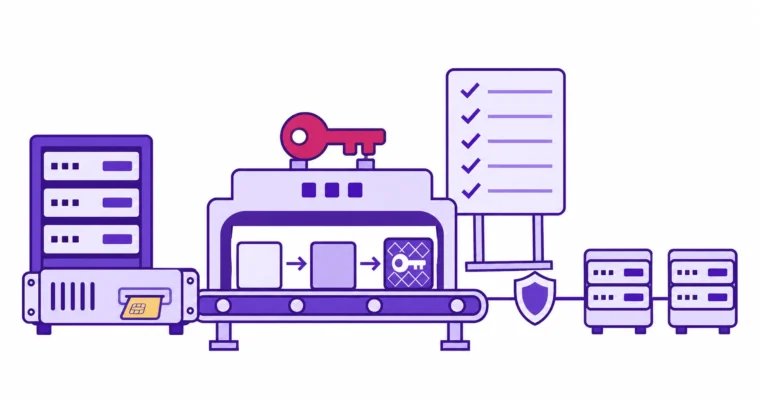
PQC and the NIST algorithm names
Post-quantum cryptography (PQC) is a set of classical algorithms designed to resist attack by quantum computers. Do not confuse it with QKD. The US National Institute of Standards and Technology (NIST) published the first three PQC standards in August 2024 (NIST):
- ML-KEM (formerly CRYSTALS-Kyber), a lattice-based key-encapsulation mechanism for establishing shared keys, in FIPS 203.
- ML-DSA (formerly CRYSTALS-Dilithium), a lattice-based digital signature, in FIPS 204.
- SLH-DSA (formerly SPHINCS+), a hash-based digital signature with larger signatures and conservative security assumptions, in FIPS 205.
Two more are in progress. FN-DSA (formerly FALCON), a lattice-based signature with smaller signatures, will be published as FIPS 206. HQC, a code-based key-encapsulation mechanism, was selected in March 2025 as a backup to ML-KEM (NIST). A listing that names these algorithms is a cryptography or security engineering role. Our PQC careers guide covers those roles in detail.
Matching your experience to the listing
Use the listing’s language for skills you actually have. If the role asks for “optical systems,” describe your laser or optics work in those words. If it asks for “RF and microwave measurement,” name your RF, antenna, or signal-processing experience. Recruiters and applicant-tracking systems both search for the listing’s terms.
Lead with transferable skills. Few candidates have done exactly this work before, and employers know it. A software engineer new to Qiskit can show strong Python, testing, and code review. A hardware engineer without cryogenic experience can show work with vacuum systems or low-noise electronics.
Show cross-disciplinary work. Quantum teams combine physicists, engineers, and computer scientists. A line such as “built data acquisition software with a physics research group” answers a requirement to work across disciplines more convincingly than a claim of teamwork.
Tailor your summary for niche roles. For a specialized position, write a short summary that states the fit directly: “Electrical engineer with five years in high-frequency signal chains, moving into qubit control hardware.”
Questions to ask the recruiter
If the listing leaves the role unclear, ask. Recruiters can give useful answers to the questions below. Candidates who ask them also show that they understand the field:
- “Which platform or modality does this role work with?” Superconducting, trapped-ion, neutral-atom, and photonic systems need different skills. Emphasize the ones that match the platform the recruiter names.
- “How is the work divided between quantum-specific tasks and general engineering?” From the answer, a candidate moving from another field learns how much of the job they can do from day one.
- “The listing mentions both [skill A] and [skill B]. Which is the day-to-day focus?” Listings often combine requirements for several roles. Prepare for the skill the recruiter names as the day-to-day focus.
- “What would success look like in the first six to 12 months?” “Deliver a working prototype” and “publish a paper” describe very different jobs.
- “Is there training for candidates who meet most of the requirements but not all?” Many employers train strong engineers on the quantum-specific parts. By asking, you raise the gap honestly.
Avoid questions the company’s website already answers.
Glossary
| Term | Meaning |
|---|---|
| QEC (quantum error correction) | encoding logical qubits across many physical qubits so errors can be detected and corrected. |
| Logical qubit | an error-corrected qubit built from many physical qubits. |
| AWG (arbitrary waveform generator) | an instrument that produces custom analog waveforms to control qubits. |
| DAC (digital-to-analog converter) | a device that converts digital values into analog signals for qubit control. |
| FPGA (field-programmable gate array) | a reconfigurable chip for real-time control, feedback, and data acquisition. |
| Dilution refrigerator | a cryostat that reaches millikelvin temperatures using a helium-3 and helium-4 mixture. |
| Transpiler or quantum compiler | software that rewrites a circuit for a specific device’s gates and connectivity. |
| SDK (software development kit) | a library for writing and running quantum programs, such as Qiskit, Cirq, or PennyLane. |
| Native gate set | the operations a hardware platform performs directly. |
| Pulse-level control | programming the analog pulses that implement gates. |
| T1 | energy relaxation time of a qubit. |
| T2 | phase coherence time of a qubit, at most twice T1. |
| RB (randomized benchmarking) | a method for measuring average gate error. |
| QV (quantum volume) | a whole-system benchmark based on the largest square random circuit a device runs successfully. |
| QKD (quantum key distribution) | sharing encryption keys using quantum states of light. |
| BB84 | the first QKD protocol, published in 1984. |
| CV-QKD | QKD using continuous variables of light such as amplitude and phase. |
| PQC (post-quantum cryptography) | classical algorithms designed to resist quantum attack. |
| ML-KEM, ML-DSA, SLH-DSA | the NIST PQC standards in FIPS 203, 204, and 205. |
| FN-DSA | the planned NIST signature standard. |
| HQC | a code-based key-encapsulation mechanism selected by NIST as a backup to ML-KEM. |
| CRQC (cryptanalytically relevant quantum computer) | a quantum computer able to break RSA and elliptic-curve cryptography. None exists today, and no one knows when one will. |
With the terms translated, you can browse quantum roles by technology area and judge which ones fit. Employers writing listings can use our guide to writing a quantum job description.
First published November 1, 2025. Revised November 10, 2026: technical corrections to the sections on gate sets, pulse-level control, coherence times, and compiler tools, and the PQC algorithm list updated to NIST’s current standards.