A neutral-atom quantum computer needs stable lasers, precisely aligned optics, and software that coordinates tightly timed operations. Neutral-atom companies therefore hire three groups above all: software engineers, laser and optics engineers, and atomic physicists. Our November 14, 2026 snapshot has 174 listings tagged neutral-atom from nine employers. About three quarters of them are in the United States. Employers mark 160 of the 174 on-site.
A listing is one advertisement on an employer’s careers site. The board does not list every employer, so these counts describe our snapshot and not the whole market.
How a neutral-atom quantum computer works
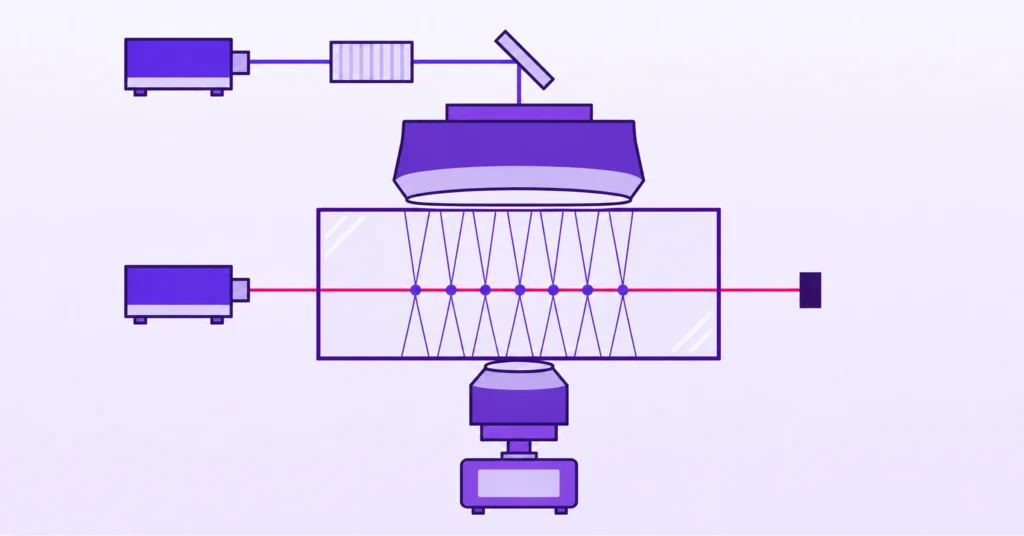
Physicists cool a cloud of atoms with lasers inside an ultra-high vacuum cell. Tightly focused laser beams, called optical tweezers, then hold single atoms in a regular array. Each trapped atom is one physical qubit. The companies use rubidium, cesium, strontium, or ytterbium.
Laser pulses perform the gates. For a two-qubit gate, engineers use the strong interaction between atoms in highly excited Rydberg states. In the common approach, called Rydberg blockade, one excited atom shifts the transition of its neighbor and stops the neighbor from being excited too. The gate entangles the pair. A camera reads the result by imaging the light each atom emits. In many designs engineers also move atoms during a computation to bring chosen pairs together, and the control software has to schedule those moves.
Some machines run as analog simulators, in which all the atoms evolve together under a programmed interaction. Others run digital gate sequences. Pasqal and QuEra build for both.
Companies build these machines from lasers, lenses, modulators, cameras, and vacuum hardware. They hire the engineers who make those parts work together.
Researchers and companies have reported these results and plans:
- A Caltech group reported an array of 6,100 cesium-atom qubits in Nature in September 2025. The group kept the atoms in superposition for about 13 seconds and moved them across the array. It had not yet entangled them, so the array is a building block and not a complete computer.
- Atom Computing and Microsoft are building Magne for QuNorth, a venture of Denmark’s export and investment fund and the Novo Nordisk Foundation. They specify the machine at 50 logical qubits built from more than 1,200 physical qubits and expect it to begin work around the start of 2027.
- QuEra targets 2028 for Libra, a system it designed for 256 logical qubits built from more than 10,000 physical qubits.
- Pasqal’s roadmap sets a goal of more than 200 logical qubits by 2029.
- The US Defense Advanced Research Projects Agency (DARPA) advanced Atom Computing to the final stage of its Quantum Benchmarking Initiative on October 7, 2026.
The Caltech array is demonstrated. The Magne, Libra, and Pasqal figures are plans. The companies use different codes and error rates. Do not compare the three logical-qubit targets directly.
The roles
We grouped the 174 listings by job title. We placed 144 of them in the nine groups below.
| Role group | Listings | What the person does | Example titles |
|---|---|---|---|
| Software | 34 | Writes compilers, control software, and emulators for the machine | Scientific Software Engineer – Compiler (QuEra); Quantum Compiler Engineer (planqc) |
| Laser and optics | 24 | Builds and stabilizes the lasers and designs the optical paths that form the tweezers and deliver the gate beams | Laser Systems Engineer (QuEra); Senior Optical Engineer (Atom Computing) |
| Research scientists and physicists | 20 | Designs gates and experiments on atom arrays and develops applications | Senior Quantum Physicist (Infleqtion); AMO Physicist (Pasqal) |
| Quantum engineering and calibration | 16 | Builds, calibrates, and operates complete machines | Quantum Machine Builder (QuEra); Quantum Engineer (Atom Computing) |
| Control electronics | 13 | Designs the FPGA and embedded systems that time laser pulses and atom moves | Sr. FPGA Engineer (QuEra); Embedded Systems Engineer – FPGA Platform (Infleqtion) |
| Error correction | 11 | Designs codes and decoders for atom arrays | Quantum Error Correction Engineer (planqc); Quantum Scientist – Decoding Theorist (QuEra) |
| Opto-mechanical and mechanical engineering | 11 | Designs the mounts, vacuum hardware, and enclosures that keep the optics aligned | Senior Opto-Mechanical Engineer (Atom Computing); Mechanical Engineer (QuEra) |
| Systems and integration | 8 | Brings the subsystems together into one machine and plans how it is tested | Principal Systems Engineer – Quantum Computing Systems (QuEra); Quantum Integration Engineer (planqc) |
| Technicians | 7 | Assembles and bonds optics and builds mechanical hardware | Optical Bonding Technician (Atom Computing); Engineering Technician (Oratomic) |
The other 30 listings are product, sales, manufacturing, corporate, and internship roles.
Laser and optics engineers have the most hardware-specific work. A machine needs separate lasers for cooling, trapping, gates, and readout. Each one must stay stable in frequency and power. Optical engineers design the lens systems that focus hundreds or thousands of tweezers onto the array. Atom Computing alone lists 11 optics roles, from optical assembly to lens design. Candidates can read about this family across all hardware types in the guide to laser and optics engineering.
Physicists and quantum engineers work in atomic, molecular, and optical physics, which employers shorten to AMO. Employers mention AMO physics in 46 of the 148 engineering and science listings. These staff design the gate sequences and find the sources of error. They also bring new machines into operation.
Control electronics engineers generate the radio-frequency signals that steer the tweezers. Acousto-optic deflectors turn those signals into beam positions. A frequency or timing error can misplace a tweezer or disturb an atom while it moves. Employers name field-programmable gate array (FPGA) skills in 18 of the 148 listings. For the whole family, see control electronics for quantum computers.
Opto-mechanical engineers keep beams aligned and stable while the building temperature changes. Engineers from microscopy, space instruments, and semiconductor tools have done this work before.
Software engineers form the largest group. QuEra lists compiler, hardware compilation, emulation, and developer experience roles under the title Scientific Software Engineer. We compare these roles with research positions in quantum software engineer vs. quantum algorithm researcher.
Who hires
| Employer | Neutral-atom listings | Main locations |
|---|---|---|
| QuEra Computing | 62 | Boston, Massachusetts; Tsukuba, Japan |
| Atom Computing | 37 | Boulder, Colorado |
| Infleqtion | 35 | Louisville, Colorado; Chicago, Illinois; Oxfordshire, England |
| planqc | 14 | Garching, Germany |
| Pasqal | 12 | Palaiseau, France |
| Oratomic | 10 | Pasadena, California |
Quantum Machines, Nu Quantum, and NVIDIA have four more listings with this tag between them. Those three companies supply several hardware types, and their listings name neutral-atom systems.
We apply the tag to roles tied to the hardware. Several of these employers have more listings in sales, corporate functions, or other product lines. Infleqtion, for example, has 53 listings in total because it also builds atomic clocks and sensors.
Oratomic is the newest of the six. It launched in March 2026 and announced US$775 million in total funding on October 8, 2026. The company says it will spend the money on more scientists and engineers, on laboratories, and on the systems it needs to build its machines.
What employers ask for
We searched the 148 engineering and science listings for the words employers use. Employers name Python in 78 of them and laser experience in 62. They mention a PhD in 76, which is about half. A mention may be a requirement, a preference, or one route among several. Atom Computing’s Senior Optical Engineer listing, for example, asks for a bachelor’s degree in optics or a related field.
We class 89 of the 174 listings as mid-level, 39 as senior, and 22 as lead or principal. Ten Oratomic listings are open to all experience levels. Three are director roles. Eleven are internships or entry-level roles.
QuEra also offers a postdoctoral route. It lists two Quantum Innovation Postdoctoral Fellow positions at US$110,000–120,000 a year. We describe industry postdocs in from postdoc to industry.
Posted salary ranges
Five employers posted the 90 annual US dollar ranges we found among the engineering and science listings. Atom Computing posted 33, QuEra 30, Infleqtion 17, Oratomic nine, and NVIDIA one.
| Group | Ranges | Median posted range | Median midpoint |
|---|---|---|---|
| All engineering and science listings | 90 | US$150,000–200,000 | US$171,000 |
| Mid-level | 42 | US$130,500–183,500 | US$162,000 |
| Senior | 22 | US$150,000–185,000 | US$170,000 |
| Lead or principal | 14 | US$170,000–211,500 | US$190,000 |
| Open to all experience levels (Oratomic) | 9 | US$200,000–350,000 | US$275,000 |
We set the levels ourselves from each title. Oratomic states in its listings that it hires at all experience levels, so we show its nine ranges in their own row. We left two postdoctoral fellowships and one director listing out of the level rows.
QuEra posts US$130,400–211,900 on eight mid-level listings. Candidates cannot tell from a range that wide what an employer will offer, so they should ask the recruiter early.
The median posted range pairs the median minimum with the median maximum. The median midpoint is the median of each listing’s own midpoint, so it need not fall halfway between the two. Employers describe most of these ranges as base salary, and a range is not an offer.
The listings in Europe and Japan have no ranges. The median midpoint across all 541 annual US dollar ranges on the board was US$173,500 on November 14, 2026. For the method, see the salary snapshot, which reports figures from November 12.
Moving in from another field
Candidates from four backgrounds have the closest skills.
- AMO physicists from cold-atom, optical lattice, or atomic clock laboratories bring experience with laser cooling, trapping, vacuum systems, and precise optical control.
- Laser and optical engineers from telecom photonics, lidar, or lithography already stabilize lasers and design lens systems.
- FPGA and embedded engineers from test equipment, radar, or communications already build precise timing systems.
- Compiler and systems software engineers can start without quantum experience at several of these employers. Each employer states in the listing what quantum background it expects.
Show evidence that matches the role. Good examples are an optical tolerance analysis, an alignment procedure, a timing design, or software that schedules operations within hardware limits.
Engineers with trapped-ion experience can move into these roles. Both hardware types use lasers, vacuum systems, and atomic physics. The differences are described in the trapped-ion guide.
Two of the 174 listings are marked remote.
Browse the open neutral-atom roles on Quantum Careers.