On November 12, 2026, 114 of the 1,137 open roles on Quantum Careers were laser, optics, or photonics engineering jobs by title. By our title classification, no other hardware discipline on the board had as many. The roles came from 13 employers, most of them building photonic, neutral-atom, or trapped-ion machines. The 87 that posted an annual US salary range had a median midpoint of US$171,000. Many of the skills these listings ask for were built in telecom, lidar, semiconductor lithography, and laser manufacturing.
Why quantum computers need so many optical engineers
Three of the main approaches to quantum computing run on light, each in a different way.
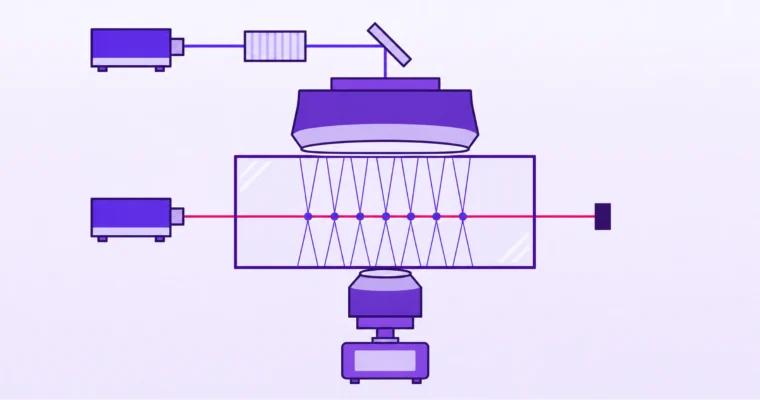
Neutral-atom machines hold individual atoms in optical tweezers, tightly focused laser beams that each trap one atom. In September 2025, a Caltech group reported an array of 6,100 cesium atoms held in optical tweezers, with coherence times of 12.6 seconds and 99.98% single-qubit gate fidelity. An array like that needs thousands of stable beams. Engineers also have to move atoms between sites and drive the high-power lasers that entangle them. QuEra Computing, Atom Computing, Pasqal, and planqc all build neutral-atom systems.
Photonic machines encode qubits in light, using single photons or, in some designs, squeezed states of light. PsiQuantum’s Omega chipset uses silicon photonics originally developed for telecom and datacenter networking, and GlobalFoundries manufactures it in New York. The engineering work covers photonic circuit design, fiber assembly, optical packaging, and validation of a very large number of optical components. Superconducting nanowire single-photon detectors (SNSPDs), operated at cryogenic temperatures, count the photons.
Trapped-ion machines use lasers to cool ions, run gates, and read out results. The larger systems are moving light delivery onto the chip with integrated photonics. Our guide to trapped-ion hardware careers covers those roles in detail.
Optics is also central to quantum sensing, atomic clocks, and quantum key distribution. Our guide to quantum sensing careers and our guide to quantum communications careers cover those fields.
The roles
The titles below come from listings open on Quantum Careers in November 2026.
Laser systems engineers
Laser engineers specify, build, and maintain the lasers a machine depends on. They lock each laser to a stable frequency reference and condition the beam. The goal is a system that runs for long periods without manual adjustment. Atom Computing and QuEra both list laser engineering roles at mid and senior level. Monarch Quantum lists senior and principal laser scientists in San Diego. Experience with diode and fiber lasers, frequency stabilization, and acousto-optic modulators transfers directly from laser manufacturers and atomic physics labs.
Optical design and optomechanics
Optical engineers design the beam paths, lenses, and imaging systems that deliver light to the qubits and collect light from them. Optomechanical engineers design mounts that keep that alignment through temperature changes and vibration. Atom Computing lists a lens designer and optical assembly and alignment engineers. Quantinuum lists diffractive optics roles and a mechanical design role for cryogenic, optical, and vacuum systems. Across all listings on the board, not only optics roles, 31 name the Zemax OpticStudio lens design software and seven name CODE V.
Integrated photonics design
Integrated photonics engineers design optical circuits on a chip. That covers waveguides, couplers, modulators, and the layout a foundry will manufacture. PsiQuantum lists circuit designers, layout engineers, silicon photonics engineers, and an engineer for active devices and circuits. Quantinuum lists photonic integrated circuit (PIC) design and metasurface design roles. Across all listings, 16 name Lumerical, a photonic simulation suite. Engineers from silicon photonics and datacenter optics companies will find the closest match here.
Test, validation, and packaging
A photonic quantum computer contains a very large number of optical components, and each one has to be measured before it goes into a system. PsiQuantum’s listings include electro-optical device validation, optical systems validation, fiber assembly process engineering, optical packaging, and test automation. Fiber attachment, yield, and automated measurement are routine work in optical transceiver manufacturing and semiconductor test, and engineers from those industries fit these roles.
Optical scientists and physicists
Optical scientists develop new techniques and characterize system performance where no established procedure exists. QuEra lists optical scientist roles for R&D and for quantum systems. Atom Computing lists an Optical Physicist. Employers usually ask for a PhD in physics or optics for these roles.
Laser safety and technicians
Neutral-atom and trapped-ion labs run high-power lasers, and QuEra lists a dedicated Laser Safety Engineer. In the US, ANSI Z136.1 is a relevant standard for laser safety programs. Optics technicians build and align optical assemblies, and IonQ lists technician roles in Oxford. Many technician roles do not require a degree. Our guide to quantum careers without a PhD covers routes into them.
Who hires
| Employer | Optics roles on Quantum Careers | Hardware | Main locations in listings |
|---|---|---|---|
| PsiQuantum | 29 | Photonic | Palo Alto, Milpitas, Daresbury (UK) |
| Monarch Quantum | 28 | Not stated | San Diego |
| Quantinuum | 13 | Trapped-ion | Broomfield, Albuquerque |
| Quandela | 12 | Photonic | Massy, Palaiseau |
| QuEra Computing | 11 | Neutral-atom | Boston |
| Atom Computing | 11 | Neutral-atom | Boulder |
| IonQ | 4 | Trapped-ion | Boston, Santa Barbara, Oxford |
| Pasqal, planqc, Oratomic | 1 each | Neutral-atom | Palaiseau, Garching, Pasadena |
| Universal Quantum | 1 | Trapped-ion | Haywards Heath |
| Sygaldry Technologies, Nu Quantum | 1 each | Not stated | Ann Arbor, Cambridge (UK) |
Six employers account for most of these roles: PsiQuantum, Monarch Quantum, Quantinuum, Quandela, QuEra, and Atom Computing. Component makers hire for quantum work too. Single Quantum, which makes SNSPDs, lists roles on the board, and IonQ lists an SNSPD systems architect in Geneva. Current listings are on the Quantum Careers job board.
Posted salary ranges for optics roles
Across the 87 laser, optics, and photonics listings with an annual US range, the median of the posted minimums was US$150,000 and the median of the maximums US$197,000. The table covers the 84 ranges at the three levels with enough listings.
| Career level | Listings | Median range | Median midpoint |
|---|---|---|---|
| Mid-level | 41 | US$130,500–175,000 | US$152,000 |
| Senior | 24 | US$150,000–197,000 | US$172,500 |
| Lead or principal | 19 | US$175,000–225,000 | US$200,000 |
Posted ranges for specific roles show the spread within the discipline.
| Role | Employer | Level | Posted range |
|---|---|---|---|
| Laser Systems Specialist | QuEra Computing | Mid-level | US$90,000–140,000 |
| Laser Engineer | Atom Computing | Mid-level | US$120,000–150,000 |
| Photonics Circuit Designer | PsiQuantum | Mid-level | US$140,000–165,000 |
| Silicon Photonics Engineer | PsiQuantum | Mid-level | US$139,800–164,300 |
| Optical Engineer, Lens Designer | Atom Computing | Mid-level | US$150,000–175,000 |
| Laser Systems Engineer | QuEra Computing | Mid-level | US$128,000–208,000 |
| Senior Optical Packaging Engineer | PsiQuantum | Senior | US$183,000–200,000 |
| Senior Optical Assembly and Alignment Engineer | Atom Computing | Senior | US$170,000–200,000 |
| Lead Diffractive Optical Engineer | Quantinuum | Lead or principal | US$148,000–199,000 |
| Principal Optical Engineer | QuEra Computing | Lead or principal | US$180,000–220,000 |
| Principal Photonic Device Design Engineer | IonQ | Lead or principal | US$212,000–275,000 |
| Principal Laser Scientist, New Laser Development | Monarch Quantum | Lead or principal | US$170,000–240,000 |
| Head of Photonics | Atom Computing | Director | US$230,000–275,000 |
PsiQuantum’s figures are its posted ranges for the San Francisco Bay Area, where all three roles are based. Quantinuum posted hourly rates of US$41 to US$55 for metasurface and photonic design internships. The salary snapshot compares optics salaries with other role families.
How to move into quantum optics work
The closest matches from outside quantum are:
- Telecom and datacenter photonics engineers, for integrated photonics design, fiber assembly, and transceiver-style test and packaging.
- Laser engineers from laser manufacturers and from medical or industrial laser companies, for laser systems and frequency stabilization.
- Lithography and metrology engineers from semiconductor equipment companies, for precision optical design and alignment.
- Lidar and augmented-reality optics engineers, for beam steering, metasurfaces, and compact optical design.
- Defense and astronomy optics engineers, for adaptive optics, spatial light modulators, and low-noise imaging.
- Optics technicians from any of these industries, for assembly and alignment roles.
In an application, name the hardware you have worked with. That means laser types and wavelengths, stabilization methods, design software, foundry processes, and the tolerances you have held. Those details tell a hiring manager more than a job title does. Our guide to decoding quantum job descriptions explains the quantum-specific terms that appear in optics listings.