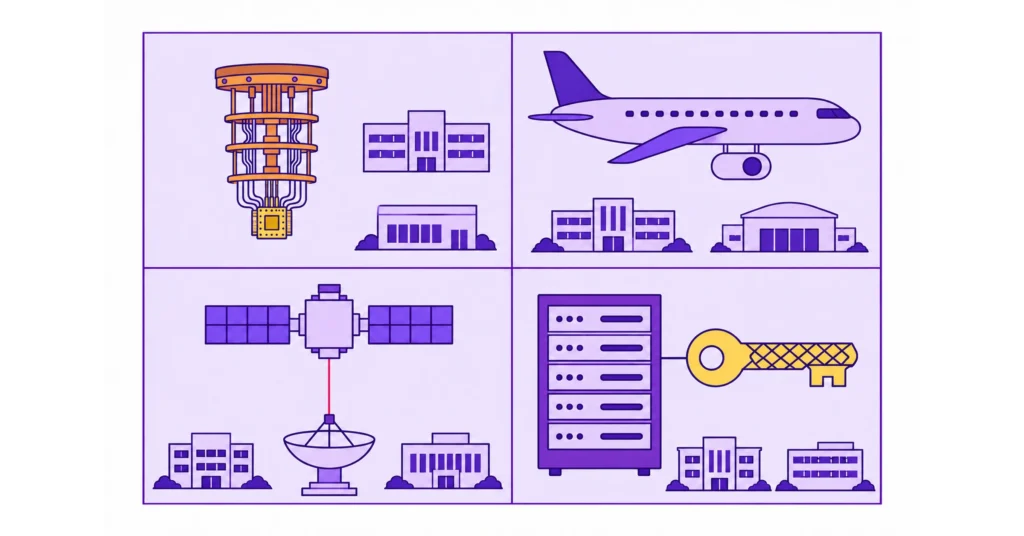
Investment in quantum technology start-ups reached US$12.6 billion in 2025, 6.3 times the 2024 total, according to McKinsey’s Quantum Technology Monitor (McKinsey). Ninety percent of it went to quantum computing. Sensing and communications shared the remaining 10 percent. Companies hire in the fields where investors put their money. Within each field, the roles a company hires for depend on its technical roadmap and on the external deadlines it has to meet.
Three timetables set most of the demand today. Computing companies are racing to build error-corrected machines. Sensing and communications companies are moving instruments out of the lab and into aircraft, vehicles, and telecom networks. And every organization that relies on public-key cryptography now has a date by which RSA and elliptic-curve cryptography have to be retired. This map of quantum talent demand follows each one to the roles it creates and the employers hiring for them.
Quantum computing and error correction
In December 2024, Google Quantum AI reported in Nature that adding more physical qubits to its surface-code logical qubit reduced the logical error rate instead of increasing it, a demonstration of operation below the error-correction threshold on a superconducting processor (Nature). Six months later IBM published a roadmap targeting Starling, a fault-tolerant system with 200 logical qubits able to run 100 million quantum gates, for 2029 at its site in Poughkeepsie, New York (The Quantum Insider). Other hardware companies have published comparable targets. These are roadmap targets, not demonstrated systems, but companies hire now to meet them.
The people who can build error correction are scarce. Riverlane, a company that builds error-correction systems, estimated in November 2025 that 600 to 700 people worldwide specialize in quantum error correction (QEC), against 5,000 to 16,000 needed by 2030, and that training a specialist can take up to 10 years (Riverlane).
Companies following those roadmaps hire in five groups.
Error correction and decoding. QEC theorists who design codes, and engineers who implement real-time decoders on field-programmable gate arrays (FPGAs) and custom chips. A decoder has to keep pace with the hardware’s measurement cycle. Building one that fast takes digital-design skills as well as physics, and companies recruit decoder engineers from signal processing and chip design.
Hardware and the systems around it. Qubit device physicists, fabrication and process engineers, cryogenic engineers who run dilution refrigerators, and radio-frequency (RF), microwave, and control-electronics engineers. Each hardware modality hires a different mix. Superconducting programs need microwave and fabrication engineers, trapped-ion and neutral-atom programs need laser, optics, and vacuum engineers, and photonic programs need integrated-photonics designers and single-photon detector specialists.
Software and compilers. Engineers who build software development kits (SDKs), compilers, circuit optimizers, and the cloud services that schedule jobs on quantum hardware alongside classical computing. Strong classical software skills count for more here than physics. Our guide to quantum careers without a PhD covers this route in.
Algorithms and applications. Algorithm researchers, and application scientists in chemistry, materials, and optimization who work with customers on pilot problems. Pharmaceutical, chemical, and financial companies hire some of these roles directly.
Integration. Engineers who connect quantum processors to high-performance computing centers and enterprise environments. These engineers work directly with customers, and demand for them grows with each system installed on a customer’s premises.
The industry is also consolidating. IonQ’s US$1.1 billion acquisition of Oxford Ionics in 2025 is one of several deals McKinsey cites as a sign of a maturing market (McKinsey). Candidates now find fewer independent employers in some modalities, larger engineering organizations, and job titles that change after one company buys another.
Current openings: quantum computing hardware and quantum computing software and algorithms.
Taking quantum sensors into the field
Quantum sensors measure time, acceleration, rotation, gravity, and magnetic fields more precisely than classical instruments, and several are close to deployment. The UK’s National Quantum Strategy sets a mission for quantum navigation systems, including clocks, to be deployed on aircraft by 2030 (UK Government). In May 2024, a consortium led by Infleqtion with BAE Systems and QinetiQ flew an optical atomic clock and elements of a quantum inertial sensor aboard a test aircraft in the UK (QinetiQ).
The move from laboratory to field changes the hiring mix. Atomic, molecular, and optical (AMO) physicists still design the core of the instrument, but the team around them now includes laser and photonics engineers, vacuum engineers, embedded and FPGA developers, systems engineers who package a sensor for vibration and temperature, and field application engineers who support customers. Employers include specialist sensor companies, defense and aerospace prime contractors, navigation and timing suppliers, and national metrology institutes. Many defense roles require a security clearance, which narrows the candidate pool considerably.
Our guide to quantum sensing careers covers the roles in detail. Current quantum sensing openings.
QKD, quantum networks, and interconnects
Quantum communications covers quantum key distribution (QKD), quantum random number generation, and the longer-term goal of networks that distribute entanglement between quantum processors. Much of the hiring is tied to national programs. The European Commission is building the European Quantum Communication Infrastructure (EuroQCI) with all 27 member states and the European Space Agency (ESA). Its first terrestrial phase ran from 2023 to 2025, and EuroQCI work from 2027 is to be funded under IRIS², the EU’s secure satellite connectivity program (European Commission). Its first QKD satellite, Eagle-1, has been delayed more than once (SpaceIntelReport). ESA now expects to launch it in late 2027 (ESA).
The roles combine optics and telecom engineering: photonics and optical systems engineers, single-photon detector specialists, network engineers who integrate QKD links into existing fiber, and security engineers who manage the keys once they exist. Quantum computing companies hire some of the same people for photonic interconnects that link processors into larger modular machines.
QKD has a narrower market than post-quantum cryptography (PQC). The US National Security Agency does not recommend it for national security systems (NSA), and most enterprises will rely on PQC instead. Our guide to quantum communications careers explains the distinction and where QKD hiring is concentrated. Current quantum communications openings.
Post-quantum cryptography deadlines
Outside quantum companies, employers hire for PQC more than for any other area on this map. Every organization that uses public-key cryptography has to migrate. The US National Institute of Standards and Technology (NIST) published its first three PQC standards in August 2024: ML-KEM (formerly CRYSTALS-Kyber), ML-DSA (formerly CRYSTALS-Dilithium), and SLH-DSA (formerly SPHINCS+). On October 27, 2026, NIST finalized its transition plan, NIST IR 8547, which deprecates quantum-vulnerable public-key algorithms after 2030 and disallows them under NIST standards after 2035 (NIST). In the EU, the member states’ coordinated roadmap asks each country to have a national transition plan by the end of 2026 and to migrate high-risk use cases by the end of 2030 (European Commission).
NIST and the EU set those dates without waiting for a cryptanalytically relevant quantum computer (CRQC), and no one knows when one will exist. Organizations have to migrate either way. Data harvested today can be decrypted later, and replacing cryptography in large systems takes years.
Most PQC roles are classical security jobs with new requirements. They include cryptographic engineers who implement and test the new algorithms, public key infrastructure (PKI) and identity architects, engineers who inventory an organization’s use of cryptography, product security engineers at hardware and software vendors, and consultants who run migration programs. Employers include banks and payment networks, telecom operators, cloud providers, government agencies and their contractors, hardware security module and chip vendors, and consulting firms. Our PQC careers guide covers the roles and the path into them. Current quantum security and PQC openings.
Where the employers are
Quantum employers cluster around universities, national laboratories, and public funding. McKinsey’s 2025 Monitor found start-ups increasingly forming in innovation clusters, with new hubs emerging in Asia (McKinsey). Public money is spread more widely than private money. Governments announced US$1.8 billion in quantum funding during 2024, and in the first months of 2025 Japan announced US$7.4 billion and Spain US$900 million (McKinsey).
North America. The US has the largest concentration of quantum computing companies and the large technology firms with quantum divisions, along with the Department of Energy national laboratories. Canada has a strong cluster in Ontario and British Columbia.
Europe. The UK, Germany, France, the Netherlands, Switzerland, Finland, and Denmark all host hardware companies and university spinouts. EU programs fund much of the communications work, and freedom of movement within the EU makes cross-border hiring routine.
Asia-Pacific. Japan made the largest of the early-2025 government funding announcements McKinsey tracked. Singapore funds quantum research and talent programs, and Australia has a strong silicon and photonics research base. India’s National Quantum Mission was approved in April 2023 with ₹6,003.65 crore for 2023–24 to 2030–31, organized around four hubs for computing, communication, sensing and metrology, and materials (DST).
Moving between these regions is common, but it involves visas, and for defense-adjacent roles, citizenship and clearance rules. Our guide to visas, relocation, and security clearances covers the practicalities. Our compensation guide explains how pay differs by employer type.
What an employer’s open roles reveal
An organization’s open roles show its roadmap more reliably than its press releases. A hardware company hiring decoder and cryogenic engineers is building toward error correction at scale. A software company hiring application scientists in chemistry is running customer pilots. A bank hiring PKI architects and cryptographic inventory analysts has started its PQC migration, whatever it has said publicly.
Candidates can use this to choose employers whose next two years match the work they want to do. You can browse open roles by technology area or look up specific companies. Employers building a team across several of these areas can talk to our executive search team about the leadership roles that anchor it.
First published November 1, 2025. Revised November 10, 2026: figures without a verifiable source were removed, company references were updated, and the sections on error correction, PQC deadlines, and public funding were rewritten with current sources. Updated November 11, 2026: the Eagle-1 launch date and the EuroQCI timeline now follow the current ESA and European Commission pages.